


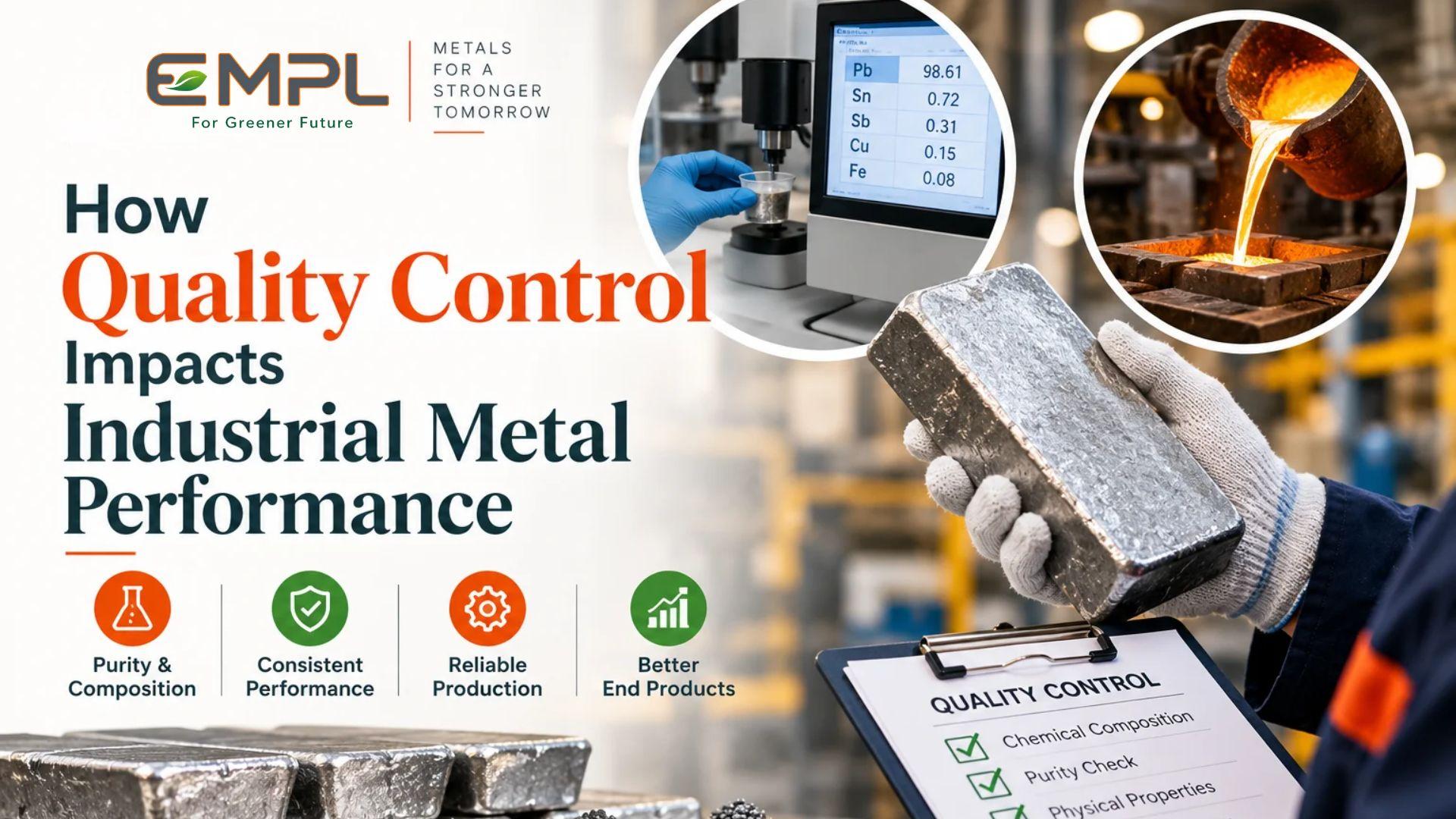
Understanding the role of purity, chemical composition, batch consistency, testing and traceability in reliable industrial metal supply.
In industrial manufacturing, the quality of raw materials plays a crucial role in determining the consistency and reliability of the finished product. Even when machinery, production processes and operating conditions remain unchanged, variations in incoming metal can affect how a material behaves during manufacturing.
This is why quality control in industrial metals is much more than a final inspection before dispatch. It involves a series of checks and processes designed to ensure that metals and alloys meet the required specifications throughout production.
For manufacturers working with lead, tin, antimony and lead alloys, parameters such as chemical composition, purity, impurity levels and batch consistency can directly influence material suitability.
Whether the application involves battery manufacturing, industrial components, specialised alloys or other metal-based products, selecting the right material is only the first step. Maintaining consistent quality is equally important.
In this article, we explore how quality control impacts industrial metal performance, why it matters to manufacturers and procurement teams, and what businesses should evaluate when choosing an industrial metal supplier.
Read More: How to Choose the Right Metal Supplier for Your Industry Needs
What Is Quality Control in Industrial Metal Manufacturing?
Quality control in industrial metal manufacturing refers to the inspection, testing and verification processes used to determine whether a material meets its defined technical and quality requirements.
These requirements may relate to chemical composition, purity, physical characteristics, dimensions, surface condition or other parameters depending on the product and its intended application.
A structured quality-control process may include:
-
Raw material inspection
-
Chemical composition analysis
-
Purity and impurity verification
-
Alloy composition control
-
Process monitoring
-
Batch-wise testing, where required
-
Product identification and traceability
-
Final inspection
-
Quality documentation
-
Packing and dispatch verification
The objective is to identify deviations, reduce avoidable quality risks and improve the consistency of the material supplied.
According to the US National Institute of Standards and Technology (NIST), elemental analysis and physical-property testing are important for confirming whether industrial commodities comply with manufacturing specifications. Reliable measurement methods and appropriate reference materials support the credibility of these checks.
For industrial buyers, the implication is straightforward: metal quality should be verified against an agreed specification rather than judged by appearance or price alone.
1. Chemical Composition Determines Material Suitability
Chemical composition is one of the most important parameters in industrial metal quality control.
It describes the elements present in a material and their respective concentrations. Depending on the metal or alloy, even a relatively small change in composition may influence its characteristics or suitability for a specific manufacturing process.
For example, lead, tin and antimony have different properties and can serve different purposes in industrial alloy systems.
-
Lead is used in applications including lead-acid batteries and radiation shielding because of its particular physical and chemical characteristics.
-
Tin is important in soldering materials, coatings and selected bearing alloys.
-
Antimony can contribute to increased hardness and strength in certain lead-based alloys.
However, the presence of these elements alone does not establish whether an alloy is suitable. The complete composition and the requirements of the application must be considered.
For this reason, manufacturers should define the required grade, composition range and permissible impurity levels before purchasing material.
Why composition control matters
Suppose a manufacturer requires a lead alloy containing a specified range of antimony. If the supplied material falls outside that range, it may not meet the manufacturer's requirements.
The material could require additional evaluation, processing adjustments or rejection, depending on the deviation and the application.
Chemical composition testing helps establish whether the material meets the agreed specification.
For industrial metal suppliers, maintaining appropriate composition controls is therefore an important part of delivering consistent materials.
2. Purity Influences Industrial Metal Performance
Metal purity refers to the proportion of the desired metal in a material, taking account of other elements and impurities.
The required purity depends on the application. Some processes require high-purity metal, while others use carefully formulated alloys in which additional elements are intentionally present.
This distinction is particularly important when purchasing lead and lead alloys.
High-purity lead and a lead alloy containing controlled amounts of tin or antimony are not interchangeable products. Each must be evaluated against its intended use and technical specification.
What industrial buyers should consider
Before placing an order, buyers should clarify:
-
Required metal grade
-
Minimum purity level, where applicable
-
Permissible impurity concentrations
-
Required alloying elements
-
Relevant technical standards
-
Available composition or test documentation
A material should not be considered superior simply because it has a higher purity percentage. The correct material is the one that meets the technical requirements of the application.
Quality control ensures that purity and composition are evaluated in the right context.
3. Batch Consistency Supports Predictable Manufacturing
Batch consistency is the ability to maintain the required material characteristics across different production batches and repeated shipments.
For industrial manufacturers, this is especially important when raw materials are used continuously in a production process.
Consider a business that receives a lead alloy for manufacturing components. The first batch meets the required specification and performs as expected. If a later batch has a different chemical composition, the manufacturer may need to investigate whether the variation affects its process.
Potential consequences can include additional testing, production adjustments, material segregation or rejection.
The actual impact depends on the material, the extent of variation and the application.
How suppliers can support batch consistency
Appropriate controls may include:
-
Establishing clear raw material specifications.
-
Monitoring alloying additions and production conditions.
-
Verifying composition at defined stages.
-
Maintaining batch identification and records.
-
Comparing test results against acceptance criteria.
-
Investigating deviations and implementing corrective actions.
These practices help establish a repeatable quality process.
For industrial buyers, the key question is not only whether a supplier can deliver one acceptable order. It is whether the supplier can consistently meet the agreed specification across repeat orders.
4. Quality Control Can Help Reduce Production Risks
Manufacturing operations depend on predictable inputs. When incoming metal does not meet the required specification, production teams may need to spend additional time identifying the cause and determining the appropriate response.
Depending on the application, material-related issues can contribute to:
-
Additional inspection and testing
-
Production interruptions
-
Process adjustments
-
Rework or material segregation
-
Rejected products
-
Increased material wastage
-
Delayed customer deliveries
Quality control helps reduce these risks by identifying deviations before the material moves too far through the manufacturing process.
It cannot eliminate every production problem, but effective inspection and process controls can help detect certain issues earlier.
Prevention is better than late-stage correction
A final inspection may identify a non-conforming product, but by that point, manufacturing resources may already have been used.
A more effective approach combines incoming material verification, process monitoring and appropriate final testing.
This allows quality to be managed throughout production rather than relying entirely on the finished-product inspection.
5. Testing Makes Metal Quality Measurable
Visual appearance can provide useful information about a material's condition, but it cannot establish its complete chemical composition or confirm every required property.
Appropriate testing is therefore an essential part of industrial metal quality control.
Depending on the material and specification, testing may include:
Chemical composition analysis: Determines the concentration of specified elements and relevant impurities.
Purity verification: Helps establish whether the material meets the required purity level.
Physical-property testing: Evaluates properties relevant to the product and its application.
Dimensional inspection: Checks dimensions where the supplied product has defined size or tolerance requirements.
Visual inspection: Identifies visible defects, surface irregularities or other observable issues.
Not every test is necessary for every metal product. The selection of test methods should depend on the material, the applicable specification and the customer's requirements.
Why documented testing matters
Testing becomes more useful when results can be connected to the relevant batch and specification.
For example, a chemical analysis report can help a buyer assess whether the measured composition falls within the required limits.
The report should identify the relevant material and provide enough information to interpret the results correctly.
Reliable quality decisions depend on appropriate testing, suitable measurement methods and clear acceptance criteria.
6. Traceability Connects Quality Across the Supply Chain
Traceability is the ability to connect a material with relevant records about its identity, processing and movement through the supply chain.
For industrial metals, traceability can help suppliers and buyers investigate quality concerns and maintain more organised records.
Depending on the operation, a traceability system may connect:
-
Raw material identification
-
Processing or production batch
-
Test results
-
Product identification
-
Storage and inventory records
-
Packing details
-
Dispatch documentation
For example, if a customer raises a question about the composition of a delivered alloy, batch identification can help the supplier locate the relevant records and investigate the issue.
Traceability does not guarantee that a product is defect-free. Instead, it improves the ability to identify material, review available evidence and respond to quality concerns.
For manufacturers managing multiple orders or repeat shipments, this can be a valuable part of supplier quality management.
7. Quality Control Is Particularly Important for Recycled Metals
Recycling plays an important role in the industrial metals sector by recovering materials that can be processed and returned to productive use.
Lead is a notable example because of the established recovery and recycling ecosystem associated with lead-acid batteries.
However, recovered metal-bearing materials may vary in composition depending on their source and processing history. Appropriate processing and verification are therefore important when producing material for industrial applications.
A simplified metal recovery and production pathway may involve:
Collection and sorting → Processing → Refining → Alloying, where required → Testing → Finished material supply
The precise stages depend on the feedstock, the production process and the final product specification.
Recycled material still needs to meet the required specification
The fact that a metal has been recovered through recycling does not, by itself, determine its quality.
Its suitability depends on the processing methods used and whether the resulting material meets the required technical parameters.
For industrial buyers, relevant considerations include composition, impurity levels, testing, traceability and compliance with applicable requirements.
In India, the Battery Waste Management Rules, 2022 established an Extended Producer Responsibility framework for battery waste management. The rules cover battery producers and other relevant stakeholders, including entities involved in recycling and refurbishment. The Central Pollution Control Board maintains an online portal for registration and related compliance processes.
This regulatory framework is relevant to the responsible management of battery waste. Product quality verification remains a separate technical requirement that must be addressed through suitable production controls and testing.
8. Refining and Alloying Require Different Quality Controls
Refining and alloying are related stages in metal production, but they serve different purposes.
Refining is used to improve the composition or purity of a metal by controlling unwanted constituents.
Alloying involves combining a base metal with specified quantities of other elements to achieve the required material characteristics.
In lead-based alloy production, for example, the quality-control process may need to address both the condition of the base lead and the quantities of alloying elements added later.
A simplified sequence is:
-
Assess the incoming material.
-
Refine the metal where required.
-
Establish the required base-metal composition.
-
Add specified alloying elements.
-
Verify the finished alloy's composition.
-
Identify the batch and maintain appropriate records.
The actual process varies by product and manufacturing method.
The important principle is that the finished alloy should be evaluated against its own specification. Testing only the base metal does not establish that the final alloy meets all required composition limits.
9. Material Quality Can Influence Manufacturing Efficiency
Manufacturing efficiency depends on several factors, including equipment, process control, operator expertise, production planning and incoming material quality.
When material characteristics are consistent with the required specification, production teams have a more predictable input to work with.
When material varies unexpectedly, the manufacturer may need to investigate the cause or adjust the process.
For certain applications, material quality can influence:
-
Melting and processing behaviour
-
Alloy formation
-
Component consistency
-
Surface finish
-
Mechanical characteristics
-
Rejection rates
-
Process repeatability
These effects are application-specific. The same variation may be significant in one process and less important in another.
The connection between quality and efficiency
A useful way to understand this relationship is:
Specified Material → Controlled Processing → Verified Output → More Predictable Production
Quality control cannot guarantee uninterrupted manufacturing, but it can help reduce uncertainty associated with material inputs.
10. Why Quality Documentation Matters to Procurement Teams
Industrial procurement involves more than confirming price and quantity. Buyers also need to know whether the material delivered matches the agreed order.
Quality documentation can support this verification process.
Depending on the product and customer requirements, relevant records may include:
-
Material grade and specification
-
Chemical composition or test results
-
Batch or lot identification
-
Quantity and product description
-
Inspection records, where applicable
-
Packing and dispatch documentation
Not every shipment requires the same set of documents. Requirements should be agreed between the buyer and supplier before the order is placed.
Clear documentation helps reduce ambiguity between the material requested, the material tested and the material delivered.
For recurring orders, consistent records can also support supplier evaluation and internal quality management.
11. Quality Control and Total Cost of Ownership
When comparing metal suppliers, the lowest quoted price may not always represent the lowest overall cost.
The total cost of using a material can include its purchase price as well as inspection, handling, processing, wastage and the consequences of non-conforming material.
For example, if an incoming batch does not meet the agreed specification, a buyer may need to spend additional time on testing, segregation or replacement arrangements.
These costs can vary considerably by industry and application.
A supplier offering consistent material, suitable documentation and dependable service may provide value beyond the quoted price alone.
What should buyers compare?
When evaluating suppliers, consider:
-
Price per unit or tonne
-
Required material specification
-
Testing and documentation
-
Historical consistency, where records are available
-
Delivery schedules
-
Packaging requirements
-
Procedures for handling non-conforming material
-
Communication and after-sales support
The objective is to evaluate the overall suitability and reliability of the supply relationship, not price in isolation.
12. How to Choose a Reliable Industrial Metal Supplier
Choosing the right supplier is an important part of maintaining quality throughout the manufacturing process.
Industrial buyers should assess both the material offered and the supplier's ability to meet recurring requirements.
Check the product specification
Confirm the exact grade, purity, composition and relevant tolerances.
Avoid relying on broad product descriptions when a more specific technical specification is required.
Understand the testing process
Ask how the material is tested and whether the methods used are appropriate for the required parameters.
Where necessary, clarify whether test results are available for individual batches.
Review traceability and documentation
Understand how batches are identified and what documentation accompanies the supplied material.
Evaluate consistency over repeat orders
A single acceptable shipment is useful, but repeated performance is more informative when establishing a long-term supply relationship.
Check supply and dispatch capabilities
Confirm the expected quantities, lead times, packaging requirements and delivery arrangements.
Discuss quality concerns in advance
Clarify how deviations will be investigated and how non-conforming material will be handled under the agreed commercial terms.
A reliable supplier relationship is built on clear specifications, appropriate verification and transparent communication.
13. Quality Control in Lead and Lead Alloy Supply
Lead and lead alloys serve a range of industrial applications, but different applications require different material characteristics.
For this reason, industrial buyers should specify their requirements clearly before sourcing lead, tin, antimony or related alloy products.
Important considerations may include:
-
Lead purity and impurity levels
-
Required alloying elements
-
Chemical composition limits
-
Intended application
-
Relevant technical standards
-
Testing requirements
-
Batch identification
-
Packaging and dispatch conditions
For lead alloys, the composition must be assessed as a whole. The presence of a particular element does not independently establish whether the material meets the customer's requirements.
The same principle applies when purchasing recycled lead or other recovered metals: the material must be suitable for the intended use and meet the applicable specification.
At EEYA Metal & Alloys Pvt. Ltd. (EMPL), our industrial metals focus includes lead, tin, antimony and alloys. For buyers evaluating metal supply options, understanding the product specification and quality requirements is an important first step towards selecting suitable material.
For product-specific information, buyers should confirm the relevant grade, composition, documentation and availability directly with the supplier.
14. The Future of Industrial Metal Quality Management
Industrial supply chains increasingly depend on clear specifications, measurable performance and reliable records.
As manufacturers manage tighter production requirements and more complex supply networks, quality management remains an important part of supplier evaluation.
Several practices are particularly relevant:
Specification-based procurement: Defining the required material characteristics before placing an order.
Appropriate testing: Using suitable methods to verify relevant parameters.
Batch-level identification: Connecting products with the records needed for traceability.
Process monitoring: Identifying deviations during production rather than relying solely on final inspection.
Responsible material management: Ensuring that recovered materials are processed appropriately and meet the requirements for their intended use.
Supplier collaboration: Maintaining clear communication about technical requirements, delivery schedules and quality concerns.
These practices help establish a more structured approach to industrial metal procurement and quality management.
Also Read: Top Industrial Uses of Lead, Tin, and Antimony – Complete Guide
Conclusion: Quality Control Is the Foundation of Consistent Industrial Metal Supply
Quality control has a direct role in establishing whether an industrial metal meets its intended specification. It connects raw material selection, refining, alloying, testing, traceability and final delivery into a structured process.
For industrial manufacturers, effective quality management can help reduce material-related uncertainty, improve process predictability and support more informed procurement decisions.
For buyers sourcing lead, tin, antimony and industrial alloys, several principles are worth remembering:
-
Define the required material specification clearly.
-
Verify purity and chemical composition where applicable.
-
Evaluate batch consistency for repeat orders.
-
Request appropriate testing and documentation.
-
Consider traceability and supplier reliability.
-
Assess overall value rather than purchase price alone.
Quality is not simply a claim made about a metal. It is something that must be defined, controlled and verified against the requirements of the application.
At EMPL, our focus is on industrial metal solutions and the importance of quality, consistency and responsible material management.
Because dependable manufacturing starts with dependable material.
Quality You Can Measure. Supply You Can Rely On.
Also Read: Industrial Lead Supply Chain in India: From Recycling to Manufacturing


