


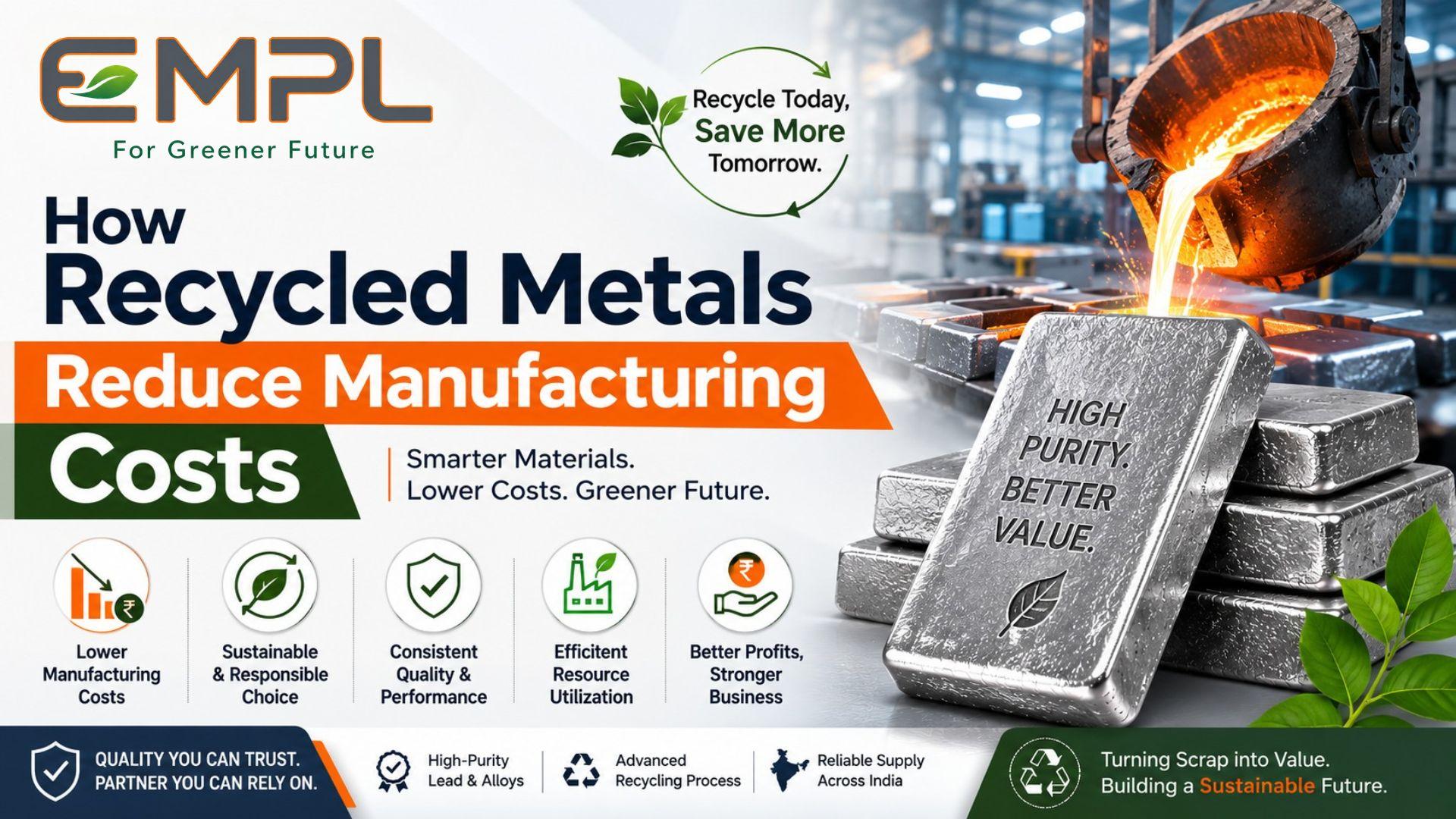
In today's competitive industrial landscape, manufacturers are under constant pressure to reduce production costs without compromising product quality. Rising raw material prices, stricter environmental regulations, and increasing customer demand for sustainable products have encouraged businesses to rethink their sourcing strategies.
One of the most effective solutions is the use of recycled metals.
Contrary to common misconceptions, recycled metals offer the same functional properties as newly mined metals while significantly lowering manufacturing costs and reducing environmental impact.
Among all recyclable metals, lead stands out as one of the world's most successfully recycled materials. Modern lead manufacturers and lead suppliers are increasingly adopting advanced recycling technologies to produce high-purity lead and lead alloys that meet stringent industrial standards.
This article explores how recycled metals help manufacturers reduce costs while supporting long-term business sustainability.
Also Read: Why Recycled Metals Are the Future of Manufacturing
Why Recycled Metals Matter in Modern Manufacturing
Manufacturing industries depend heavily on metals such as lead, aluminum, copper, steel, and zinc. Traditionally, these metals were obtained through mining and refining, processes that require enormous amounts of energy, natural resources, and investment.
Metal recycling changes this equation.
Instead of extracting raw materials from the earth, recyclable metals are collected, processed, refined, and transformed into high-quality industrial products.
For industries relying on lead manufacturers, recycled lead provides an efficient and sustainable alternative without sacrificing quality or performance.
Also Read:
1. Lower Raw Material Costs
Raw materials represent one of the largest expenses in industrial manufacturing.
Mining, transportation, ore processing, and refining significantly increase the cost of virgin metals.
Recycling eliminates many of these expensive processes.
As a result, recycled lead manufacturers can produce high-quality lead at lower production costs, allowing businesses to benefit from more competitive pricing.
Cost Benefits
- Reduced mining expenses
- Lower refining costs
- Less dependence on imported raw materials
- Stable material availability
- Improved procurement efficiency
Businesses working with experienced lead suppliers often enjoy long-term pricing stability compared to relying solely on newly mined materials.
2. Reduced Energy Consumption
Producing metals from recycled materials requires substantially less energy than producing them from mined ore.
Lead recycling consumes significantly less energy compared to primary lead production.
Lower energy consumption means:
- Reduced manufacturing expenses
- Lower operational costs
- Improved production efficiency
- Better profitability
For manufacturers producing thousands of tons annually, these savings can translate into significant financial advantages.
3. Improved Supply Chain Stability
Global supply chains are increasingly vulnerable to:
- Mining disruptions
- International trade restrictions
- Transportation challenges
- Rising fuel prices
- Raw material shortages
Working with trusted lead manufacturers that utilize recycled materials helps businesses maintain a more reliable and consistent supply of industrial metals.
Stable supply chains reduce:
- Production downtime
- Emergency procurement
- Inventory shortages
- Unexpected price fluctuations
4. Consistent Material Quality
A common myth is that recycled metals are inferior.
Modern recycling technologies have completely transformed the industry.
Today's advanced recycling facilities use:
- Chemical composition analysis
- Spectrometric testing
- Purity verification
- Controlled refining processes
- Laboratory quality inspection
Reliable lead recycling companies ensure that recycled lead meets industrial specifications and performs just as effectively as primary lead in demanding applications.
5. Reduced Waste Disposal Costs
Industrial waste management is becoming increasingly expensive.
By incorporating recycled metals into manufacturing processes, companies can significantly reduce waste generation.
Benefits include:
- Lower landfill expenses
- Reduced disposal charges
- Better material utilization
- Higher production efficiency
This contributes to lean manufacturing practices while improving profitability.
6. Lower Environmental Compliance Costs
Governments worldwide are implementing stricter environmental regulations.
Businesses that source materials from responsible lead suppliers and sustainable manufacturers often find it easier to meet environmental standards.
Advantages include:
- Reduced carbon emissions
- Easier regulatory compliance
- Better ESG performance
- Improved environmental reputation
- Reduced future compliance risks
Sustainability is no longer just an environmental responsibility—it is a competitive business advantage.
7. Better Return on Investment (ROI)
Reducing manufacturing costs directly improves profitability.
When companies purchase from reliable lead manufacturers using recycled materials, they benefit from:
- Lower procurement costs
- Reduced operational expenses
- Consistent production
- Higher customer satisfaction
- Better product reliability
Together, these improvements increase overall return on investment.
Industries That Benefit from Recycled Lead
Recycled lead is widely used across multiple industries because of its excellent physical and chemical properties.
Common applications include:
Battery Manufacturing
Lead-acid batteries remain one of the largest consumers of recycled lead worldwide.
Automotive Industry
Used in batteries, electrical systems, and specialized industrial components.
Cable Manufacturing
Lead provides corrosion resistance and durability for industrial cable applications.
Radiation Shielding
Hospitals, laboratories, and nuclear facilities rely on high-purity lead for radiation protection.
Chemical Industry
Lead's resistance to corrosion makes it suitable for demanding chemical processing environments.
Infrastructure Projects
Lead alloys are used in specialized engineering and industrial construction applications.
Why Sustainability Also Saves Money
Many organizations assume sustainability increases costs.
The reality is often the opposite.
Sustainable sourcing helps businesses:
✔ Lower operating costs
✔ Improve brand reputation
✔ Win environmentally conscious customers
✔ Meet ESG objectives
✔ Improve investor confidence
✔ Reduce long-term business risks
Responsible recycling creates value throughout the supply chain.
Also Read: How to Choose the Right Metal Supplier for Your Industry Needs
Choosing the Right Recycled Lead Supplier
Not all suppliers maintain the same standards.
When selecting a lead supplier, consider:
Quality Assurance
Look for manufacturers with rigorous laboratory testing and quality control systems.
Manufacturing Experience
Experienced lead manufacturers understand industry-specific requirements and maintain consistent production standards.
Reliable Supply
Choose suppliers with strong production capacity and dependable logistics.
Sustainability Practices
Work with companies committed to responsible recycling and environmental stewardship.
Technical Expertise
A knowledgeable supplier can recommend the most suitable lead or lead alloy for your application.
Why Choose EEYA Metal & Alloys Pvt. Ltd.?
At EEYA Metal & Alloys Pvt. Ltd. (EMPL), sustainability and quality go hand in hand.
As a trusted lead manufacturer, lead supplier, and lead recycling company, we transform responsibly sourced materials into premium-quality lead and lead alloys for industries across India.
Our commitment includes:
- Advanced recycling technology
- High-purity lead production
- Strict laboratory quality testing
- Reliable nationwide supply
- Customized lead alloy solutions
- Sustainable manufacturing practices
- Customer-focused technical support
Whether you're in battery manufacturing, infrastructure, automotive, or industrial production, EMPL delivers reliable metal solutions that help reduce costs while supporting sustainable growth.
Conclusion
Recycled metals have become a cornerstone of modern manufacturing by offering businesses a smarter way to reduce costs without compromising quality.
From lower raw material expenses and reduced energy consumption to improved supply chain stability and environmental compliance, recycled lead delivers measurable economic and operational advantages.
By partnering with experienced lead manufacturers, dependable lead suppliers, and responsible lead recycling companies, manufacturers can strengthen profitability, enhance sustainability, and build more resilient supply chains.
As industries continue to embrace circular economy principles, recycled metals will play an even greater role in shaping the future of manufacturing.
Also Read: Top Applications of Lead in Modern Industries
Frequently Asked Questions (FAQs)
1. Does recycled lead have the same quality as primary lead?
Yes. Modern recycling and refining technologies ensure recycled lead meets strict industrial quality standards and performs comparably to primary lead.
2. Why is recycled lead more cost-effective?
Recycled lead reduces expenses related to mining, ore processing, and energy consumption, resulting in lower production costs.
3. Which industries use recycled lead?
Battery manufacturing, automotive, cable manufacturing, radiation shielding, chemical processing, and infrastructure sectors all rely heavily on recycled lead.
4. How does recycling support sustainable manufacturing?
Metal recycling conserves natural resources, reduces energy use, lowers carbon emissions, and minimizes industrial waste, making manufacturing more sustainable.


