

India's industrial lead supply chain is closely connected to one of the country's most established circular material ecosystems: lead recycling.
Lead is used across several industrial applications, but the battery sector remains a major driver of demand. According to the Indian Bureau of Mines' Indian Minerals Yearbook 2024, the battery industry accounts for about 80% of lead consumption in India, with the remainder used across applications such as pigments and compounds, rolled and extruded products, alloys, cable sheathing and other industries.
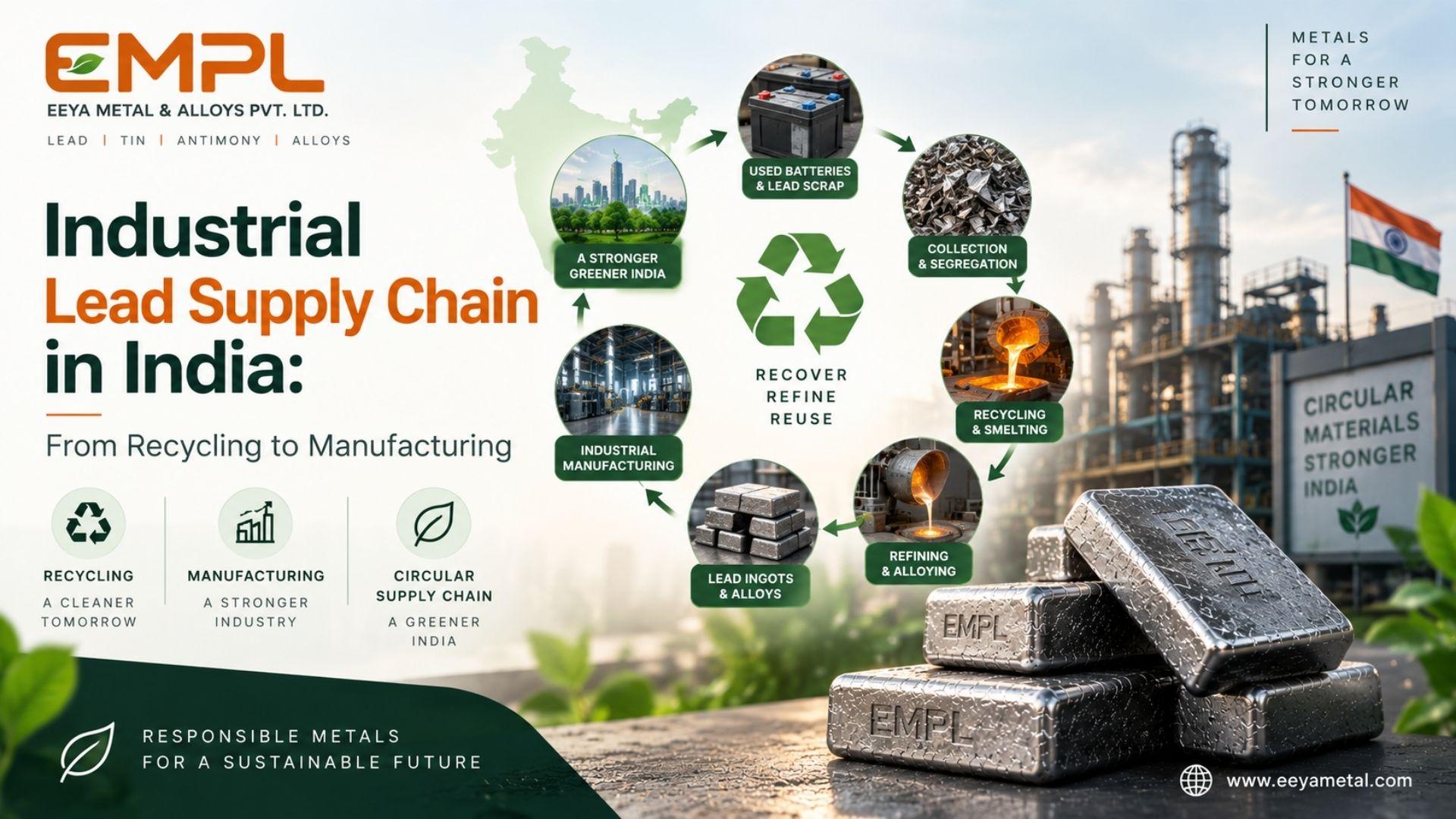
What makes the lead supply chain particularly interesting is that the material can move through a circular loop:
Industrial Use → End-of-Life Material → Collection → Recycling → Refining → Lead/Lead Alloys → Manufacturing → Industrial Use
This circularity makes lead recycling and secondary lead production an important part of India's industrial metal ecosystem.
But the journey from recycled material to a usable industrial product involves much more than simply collecting scrap. It requires controlled processing, refining, alloying, testing, compliance and reliable supply management.
Let's understand how the industrial lead supply chain in India works and what industrial buyers should consider when sourcing lead and lead alloys.
Also Read: Lead Ingots: Types, Grades & Industrial Applications
What Is the Industrial Lead Supply Chain?
The industrial lead supply chain includes all the activities involved in moving lead-bearing materials from their original source through processing and manufacturing and ultimately to the customer.
A simplified Indian lead supply chain can be represented as:
Lead-Bearing Raw Material
↓
Collection & Segregation
↓
Transportation
↓
Recycling / Smelting
↓
Refining
↓
Alloying & Composition Control
↓
Quality Testing
↓
Casting into Ingots / Other Forms
↓
Storage & Dispatch
↓
Industrial Manufacturing
At the end of the product's useful life, lead-containing materials can potentially return to the recycling stream, creating a circular supply chain.
This is one of the major characteristics that differentiates lead from many other industrial materials.
The Indian Bureau of Mines notes that lead used in batteries, cable sheathing and radiation-related applications is recyclable without losing its fundamental properties.
1. Where Does Industrial Lead Come From?
Lead entering India's industrial supply chain can come from different sources.
Broadly, supply can be divided into:
Primary Lead
Primary lead originates from mineral extraction and subsequent processing and refining.
Secondary or Recycled Lead
Secondary lead is recovered from lead-containing products and industrial scrap and then processed into usable metal.
For India's circular lead ecosystem, secondary material is particularly important because lead-acid batteries provide a significant source of recoverable lead.
A NITI Aayog report described India's lead-acid battery supply chain as relatively integrated and circular, with established local manufacturing and recycling infrastructure.
2. Used Lead-Acid Batteries: A Major Source of Recycled Lead
Lead-acid batteries are one of the most important sources of recyclable lead.
They are used extensively in:
- Automobiles
- Backup power systems
- Telecommunications
- Industrial equipment
- Solar and stationary applications
- Other energy-storage systems
When these batteries reach the end of their useful life, they become a valuable source of recoverable materials.
The supply chain therefore does not simply end when a battery stops working.
Instead, it can become the starting point for another material cycle:
Used Battery → Recycling → Refined Lead → New Industrial Product
This is the foundation of the circular lead economy.
Also Read: Lead Purity Explained: What Industrial Buyers Should Know
3. Collection: The First Critical Stage
Before lead can be recycled, end-of-life material needs to enter an appropriate collection channel.
Potential sources include:
- Battery dealers
- Automotive workshops
- Industrial facilities
- Battery manufacturers
- Scrap collection networks
- Authorized collection systems
- Other industrial scrap sources
Collection is important because the quality and traceability of the incoming material can influence subsequent recycling and processing.
The ideal supply chain therefore requires organized collection and responsible handling.
4. Why Organized Recycling Matters
Lead recycling involves hazardous materials and therefore requires appropriate environmental, health and safety controls.
India's Battery Waste Management Rules, 2022 established an Extended Producer Responsibility framework covering producers, recyclers, refurbishers and other participants in the battery lifecycle. The CPCB operates a centralized EPR portal for registration, reporting and related compliance activities.
The CPCB states that the portal is intended to improve accountability, traceability and transparency in fulfilling EPR obligations.
This is important because a strong industrial lead supply chain is not simply about maximizing material recovery.
It is also about ensuring that recycling takes place through appropriate and compliant processes.
5. From Waste Battery to Recovered Lead
Once lead-acid batteries enter a recycling facility, the material goes through several processing stages.
A simplified recycling route can include:
Collection
End-of-life batteries are received and recorded.
Segregation and Preparation
Different components and materials are separated or prepared for processing.
Processing / Smelting
Lead-bearing material is processed to recover metallic lead.
Refining
Recovered lead is further treated to control impurities and achieve the required specification.
Alloying
Where required, controlled alloying elements are added to produce specific lead alloy grades.
Casting
The finished metal can then be cast into ingots or other required forms.
Quality Testing
Chemical composition and other relevant parameters are verified against the required specification.
The exact process and equipment depend on the recycling facility and the material being processed.
6. Refining: Turning Recovered Metal into Industrial-Grade Material
Recycling does not automatically mean that recovered metal is ready for industrial use.
The recovered material may contain various elements and impurities.
This is where refining becomes critical.
The objective is to produce lead that meets a defined chemical specification.
Depending on the intended product, this may involve controlling:
- Lead content
- Antimony
- Tin
- Calcium
- Copper
- Arsenic
- Bismuth
- Iron
- Zinc
- Other trace elements
For industrial buyers, the important point is that the final material specification matters more than simply whether the source material was recycled.
A properly processed recycled lead product can become a reliable industrial raw material when the required refining, composition control and quality testing are in place.
Also Read: 7 Factors to Consider Before Choosing an Industrial Metal Supplier
7. From Refined Lead to Lead Alloys
Not every industrial application requires pure or high-purity lead.
Many manufacturing processes require lead alloys with controlled additions of other elements.
Depending on the application, manufacturers may use alloy systems involving:
- Antimony
- Calcium
- Tin
- Copper
- Other controlled elements
Alloying changes the characteristics of lead and can be used to achieve specific requirements related to mechanical or electrochemical performance, casting behaviour and other application-specific properties.
For example, different lead alloy compositions are used in various lead-acid battery manufacturing applications.
Therefore, the lead supply chain does not end with refining.
It can continue through:
Refined Lead → Alloying → Testing → Application-Specific Material
8. Quality Testing Is a Critical Link
For industrial manufacturing, material quality cannot be determined simply by appearance.
Two lead ingots can look similar while having different chemical compositions.
This is why quality control should form an important part of the supply chain.
Depending on the product, relevant quality checks may include:
- Chemical composition
- Lead purity
- Alloying-element concentration
- Impurity levels
- Batch consistency
- Physical characteristics
- Customer-specific specifications
For recurring industrial supply, maintaining consistent chemistry between batches can be particularly important.
9. The Importance of Batch Traceability
A modern industrial lead supply chain should ideally allow material to be traced through relevant stages.
A simplified traceability chain might look like:
Raw Material → Processing Batch → Refining → Alloying → Testing → Finished Batch → Dispatch
This can help suppliers and buyers identify the history of a particular material batch.
Traceability becomes especially useful when:
- Investigating quality issues
- Comparing different batches
- Reviewing test results
- Managing customer complaints
- Maintaining procurement records
- Supporting quality audits
The CPCB's EPR framework also places emphasis on improving accountability and traceability within the battery recycling ecosystem.
10. Lead Ingots: Connecting Recycling with Manufacturing
Once refined lead or lead alloy meets the required specification, it can be cast into forms suitable for industrial handling and further processing.
Lead ingots are one of the most common forms used for industrial supply.
Ingot specifications can include:
- Grade
- Purity
- Chemical composition
- Alloy composition
- Weight
- Dimensions
- Batch identification
- Packaging
The appropriate ingot specification depends on the customer's production process.
For example, a battery manufacturer may require a specific lead alloy composition, while another industrial customer may require high-purity lead.
11. Where Does Recycled Lead Go?
Recycled lead can return to multiple industrial applications.
The largest demand segment in India is the battery industry.
Other applications can include:
Lead Alloys
Used in applications where controlled alloy chemistry is required.
Cable Sheathing
Lead has historically been used in specialized cable-sheathing applications.
Radiation Shielding
Lead's density and radiation attenuation characteristics make it useful in shielding applications.
Rolled and Extruded Products
Lead can be processed into various industrial forms.
Chemical and Industrial Applications
Lead and lead compounds can be used in selected industrial processes.
The Indian Bureau of Mines identifies batteries as the dominant lead-consuming sector while also listing alloys, cable sheathing, rolled and extruded products and other uses.
12. The Role of Lead Recycling in a Circular Economy
The circular economy concept focuses on keeping materials in productive use for as long as possible rather than treating them as single-use resources.
Lead is particularly suitable for this approach because it can be recovered and recycled.
The cycle can look like:
Stage 1
Lead is used in an industrial product.
Stage 2
The product reaches the end of its useful life.
Stage 3
The lead-containing material is collected.
Stage 4
The material is processed and recycled.
Stage 5
Lead is refined and tested.
Stage 6
The material is converted into lead or lead alloys.
Stage 7
The material enters manufacturing again.
This creates a closed-loop or circular material pathway.
13. India's Regulatory Framework
For companies involved in battery recycling, regulatory compliance is an important part of the supply chain.
The Battery Waste Management Rules, 2022 apply broadly to batteries and establish EPR obligations for producers. Producers, recyclers and refurbishers are required to register through the centralized CPCB portal, with recyclers and refurbishers also subject to registration requirements involving the concerned SPCB/PCC through the system.
The CPCB portal also provides guidance and information related to:
- Recycler registration
- Producer registration
- EPR certificates
- Battery waste handling
- Recycling guidelines
- Annual reporting
- Compliance
This regulatory structure is intended to make battery waste management more organized and transparent.
Also Read: Lead Recycling Process: From Scrap Collection to High-Purity Lead | Best Lead Supplier in India
14. The Scale of India's Lead Recycling Ecosystem
The scale of India's organized lead recycling infrastructure highlights how important the secondary lead industry has become.
The Indian Bureau of Mines reported 672 registered lead recycling units with combined capacity of approximately 3.53 million tonnes per annum for processing used lead batteries and lead waste/scrap.
The CPCB's current EPR system also provides a centralized mechanism for registered producers and recyclers.
Its national dashboard shows substantial EPR activity associated with lead, demonstrating the significant role lead plays within India's battery-waste management framework.
These figures underline an important point:
Lead recycling is not a small side activity—it is an important component of India's industrial material ecosystem.
15. Supply Reliability Is Just as Important as Recycling
Recycling creates the material.
But industrial manufacturing requires something more:
Reliable availability.
A manufacturer cannot plan production effectively if the required metal is inconsistently available.
Industrial buyers therefore need suppliers that can provide:
- Consistent quality
- Consistent specifications
- Predictable quantities
- Regular availability
- Reliable dispatch
- Proper documentation
- Batch traceability
This becomes particularly important for industries where lead is a critical production input.
16. Why Material Consistency Matters
Imagine a manufacturer receives a lead alloy with a particular chemical composition.
The production team establishes its process parameters around that specification.
If the next shipment contains substantially different alloy chemistry, the downstream process may behave differently.
Potential consequences can include:
- Process variation
- Production adjustments
- Quality issues
- Rejections
- Material wastage
- Additional testing
This is why industrial lead buyers should evaluate suppliers on consistency across multiple batches, not just the quality of one shipment.
17. Choosing the Right Lead Supplier in India
For industrial buyers, selecting a lead supplier should involve more than comparing quotations.
Important evaluation factors include:
Product Specification
Does the supplier provide the required purity or alloy grade?
Quality Control
How is the chemical composition verified?
Manufacturing Capability
Does the supplier have the infrastructure required to consistently produce the required material?
Recycling & Raw Material Practices
If recycled material is involved, how is it processed and refined?
Traceability
Can batches be identified and linked to quality records?
Supply Capacity
Can the supplier meet recurring volume requirements?
Delivery Reliability
Can material be supplied according to production schedules?
Documentation
Can the supplier provide relevant quality and shipment documentation?
Compliance
Does the supplier operate within applicable regulatory requirements?
A supplier that performs well across these areas can provide much greater value than a supplier competing only on price.
18. Why the Lead Supply Chain Is Becoming More Important
India's industrial ecosystem is evolving toward greater emphasis on:
- Resource efficiency
- Recycling
- Responsible waste management
- Supply-chain visibility
- EPR compliance
- Domestic manufacturing
- Material security
- Sustainable sourcing
Lead fits naturally into several of these priorities because it combines significant industrial demand with strong recyclability.
As battery and other industrial applications continue to require lead-based materials, the ability to efficiently recover, refine and return lead to manufacturing becomes increasingly important.
19. From Recycling to Manufacturing: The Complete Picture
The Indian industrial lead supply chain can therefore be understood as a connected ecosystem rather than a series of independent activities.
1. Collection
End-of-life batteries and lead-bearing materials enter the recovery network.
2. Segregation & Preparation
Materials are prepared for safe and efficient processing.
3. Recycling
Lead-bearing material is processed to recover metallic lead.
4. Refining
Recovered lead is refined to meet the required quality specification.
5. Alloying
Specific elements can be added to create application-specific lead alloys.
6. Testing
Chemical composition and relevant quality parameters are verified.
7. Casting
Lead or alloy is converted into ingots or required product forms.
8. Distribution
Finished material is stored, transported and supplied to industrial customers.
9. Manufacturing
The material becomes part of a new industrial product.
10. Recovery
At the end of the product's useful life, recyclable lead can potentially re-enter the supply chain.
And the cycle continues.
EMPL and the Circular Lead Supply Chain
At EEYA Metal & Alloys Pvt. Ltd. (EMPL), our focus is on supplying lead, tin, antimony and lead alloy solutions for industrial requirements while emphasizing quality, consistency and responsible manufacturing.
For industrial customers, the value of a metal supplier goes beyond supplying finished ingots.
A dependable supply partner needs to understand the entire material journey—from raw material and recycling through refining, alloying, testing and final delivery.
The objective is simple:
Reliable materials for reliable manufacturing.
And when those materials are produced through responsible recycling and controlled manufacturing processes, the supply chain can support both industrial performance and a more circular use of resources.
The Future of India's Lead Supply Chain
India already has an established ecosystem for lead recycling, but the next stage of development will depend on how effectively the industry improves:
- Organized collection
- Responsible recycling
- Process efficiency
- Quality control
- Traceability
- Regulatory compliance
- Material consistency
- Supply reliability
The CPCB's EPR framework is already creating greater digital visibility around battery producers, recyclers and EPR obligations.
At the same time, India's established recycling infrastructure provides a foundation for keeping lead within the industrial economy instead of losing valuable material after its first use.
Final Thoughts
The industrial lead supply chain in India is much more than a route from scrap to finished metal.
It is a circular ecosystem connecting:
Collection → Recycling → Refining → Alloying → Testing → Manufacturing → Recovery
The strength of this ecosystem depends on every stage working responsibly and efficiently.
For industrial buyers, the most important question is not simply:
"Where can I buy lead?"
It is:
"Can my supplier consistently provide the right material, with the right specification, through a reliable and responsible supply chain?"
That is where quality, traceability, recycling, manufacturing capability and supply reliability come together.


