


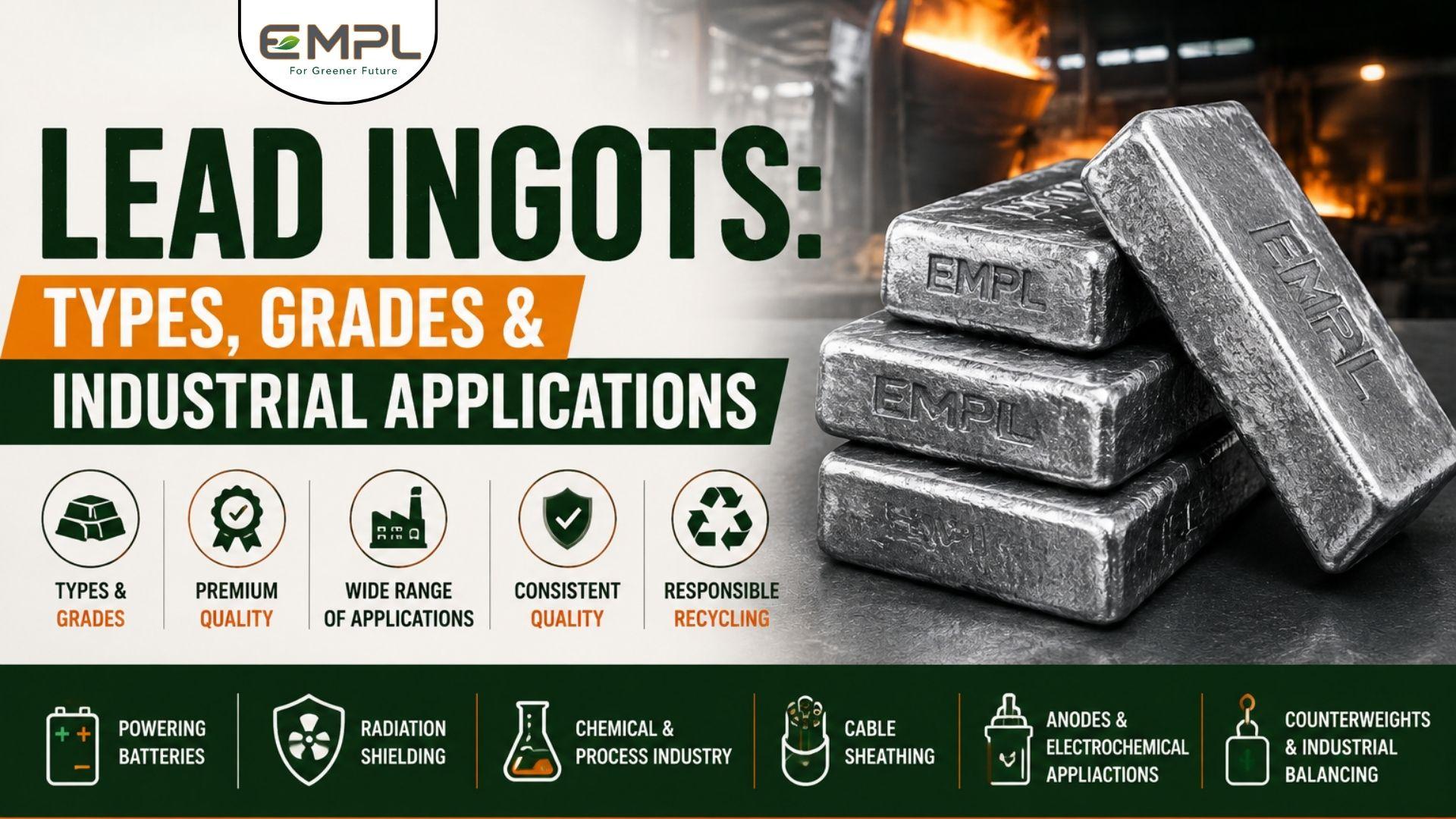
Lead ingots are an important form of refined and alloyed lead used across several industrial manufacturing processes. Their standardized shape makes them convenient to handle, transport, store, remelt and process into finished components or other lead-based products.
For industrial buyers, however, lead ingots are not simply blocks of metal. Different grades, purity levels and alloy compositions are designed for different applications. Selecting the right material can directly influence manufacturing consistency, product performance and overall process efficiency.
From lead-acid batteries and radiation shielding to cable sheathing, chemical processing, anodes and specialized industrial applications, the suitability of a lead ingot depends largely on its purity, chemical composition and intended use.
This guide explains the major types of lead ingots, commonly used grades and their industrial applications, along with the key factors buyers should consider when sourcing them.
What Are Lead Ingots?
A lead ingot is a cast form of lead produced by melting, refining or alloying lead-bearing material and then solidifying it into a defined shape.
Lead ingots can be manufactured from:
- Refined lead
- Recycled lead
- Remelted lead
- Lead-bearing secondary materials
- Controlled lead alloy compositions
Depending on the manufacturing process and specification, ingots can be produced with different levels of purity and different concentrations of alloying elements such as antimony, calcium, tin, silver, copper or tellurium.
Commercial manufacturers offer both pure/refined lead ingots and alloyed products for industrial applications. For example, Indian manufacturers publicly list refined lead in the 99.97–99.99% range as well as antimony-lead and calcium-tin alloy products.
The key point is that the right lead ingot grade depends on the application—not simply on the highest possible purity.
Why Are Lead Ingots Important for Industry?
Lead has a combination of properties that makes it useful in applications where other metals may not provide the same performance.
Important characteristics include:
- High density
- Good corrosion resistance
- Malleability
- Relatively low melting point
- Radiation attenuation capability
- Good resistance to certain chemical environments
- Ability to form useful alloys
- High recyclability
Lead's high density and atomic number make it particularly effective for X-ray and gamma-ray shielding, while its corrosion resistance and electrochemical properties support applications such as batteries and chemical-process equipment.
Because lead can also be alloyed with small quantities of other metals, manufacturers can modify its properties for specific industrial requirements.
Also Read: Lead Manufacturers in India: Quality, Capacity & Supply Reliability
Major Types of Lead Ingots
Lead ingots can broadly be divided into pure/refined lead ingots and lead alloy ingots.
1. Pure Lead Ingots
Pure lead ingots contain a very high proportion of lead with tightly controlled impurity levels.
Commercial products can be available in different purity specifications depending on the manufacturer and application. For example, some Indian producers list refined lead at approximately 99.97–99.99% purity.
Key characteristics
Pure lead is known for:
- High density
- Excellent malleability
- Good corrosion resistance
- Easy melting and casting
- Effective radiation attenuation
Common applications
Pure lead ingots can be used in:
- Lead-acid battery manufacturing
- Radiation shielding
- Industrial castings
- Counterweights and ballast
- Chemical applications
- Lead sheet and plate production
- Specialized manufacturing processes
The exact grade should always be selected according to the technical specification of the final product.
2. Antimonial Lead Ingots
Antimonial lead is produced by adding antimony (Sb) to lead.
The addition of antimony can improve hardness, strength and dimensional stability compared with unalloyed lead. Different compositions are used for different applications.
Common applications
Antimonial lead alloys are used in areas such as:
- Battery grid manufacturing
- Industrial castings
- Certain anodes
- Cable sheathing
- Specialized lead components
The required antimony percentage depends on the intended application, so buyers should not select an antimonial grade based solely on a generic percentage.
3. Lead-Calcium Alloys
Lead-calcium alloys contain controlled additions of calcium and may also contain elements such as tin or aluminium.
These alloys are particularly important in lead-acid battery manufacturing, where alloy composition influences grid properties and battery performance.
Lead-calcium systems have become increasingly important for battery applications because of their low hydrogen-evolution characteristics and suitability for sealed battery designs.
Applications
Lead-calcium alloys are commonly associated with:
- Automotive batteries
- Industrial batteries
- Maintenance-free batteries
- Valve-regulated lead-acid batteries
- Battery grid manufacturing
For battery manufacturers, composition control is especially important because even relatively small variations in alloying elements can influence processing and final product characteristics.
4. Lead-Calcium-Tin Alloys
Lead-calcium-tin alloys combine calcium and tin with lead to provide properties suitable for particular battery-grid applications.
These alloys are used in the production of positive and negative grids for certain lead-acid battery designs.
Typical applications
They can be used in:
- Automotive batteries
- VRLA batteries
- Industrial battery systems
- Battery grid manufacturing
The exact composition should be specified according to the battery manufacturer's process and technical requirements.
5. Lead-Tin Alloys
Lead-tin alloys are produced by adding controlled amounts of tin to lead.
Lead-tin systems have historically been important in soldering and other specialized applications, although modern regulatory and application requirements vary considerably by product and market.
Lead-tin alloys are also used in certain bearing and plating-related applications.
Applications include:
- Industrial solder production
- Plating applications
- Specialized bearing materials
- Certain manufacturing processes
The required tin percentage can vary significantly depending on the final application.
6. Lead-Silver Alloys
Silver can be added to lead when enhanced performance is required for specific applications.
Lead-silver alloys are particularly relevant to certain anode applications, including demanding electrochemical environments. Lead alloy references identify silver-bearing lead among alloy systems used for anodes and specialized soldering applications.
These materials are generally selected based on specific process requirements rather than general-purpose lead applications.
7. Other Specialized Lead Alloys
Depending on the application, lead can also be alloyed with elements such as:
- Copper
- Tellurium
- Arsenic
- Silver
- Tin
- Antimony
These additions can influence characteristics such as hardness, strength, corrosion behaviour, creep resistance, casting behaviour or electrochemical performance.
For example, lead-tellurium and lead-copper systems are used in certain specialized applications, while multi-element alloys can be developed for particular industrial requirements.
Also Read: How to Choose the Right Metal Supplier for Your Industry Needs
Understanding Lead Ingot Grades
One of the most important points for industrial buyers is that there is no single "best" lead ingot grade for every application.
A grade should be evaluated according to:
1. Lead Purity
Purity indicates how much of the material consists of lead and how tightly other elements are controlled.
For example, commercially available refined lead ingots may be specified at 99.97%, 99.98% or 99.99% purity depending on the product and manufacturer.
2. Alloy Composition
For alloyed ingots, the percentage of antimony, calcium, tin or other alloying elements is often more important than simply stating the lead percentage.
3. Impurity Limits
Elements such as:
- Copper
- Iron
- Zinc
- Arsenic
- Antimony
- Tin
- Bismuth
- Cadmium
- Silver
may need to be controlled according to the application.
4. Physical Form
Lead ingots can be supplied in different dimensions and weights. Some producers offer standard 25 kg ingots, while larger formats such as jumbo ingots may also be available.
5. Customer Specification
Certain industrial applications require customized alloy chemistry rather than an off-the-shelf grade.
Therefore, buyers should provide the supplier with the required chemical composition and application details before placing an order.
Industrial Applications of Lead Ingots
Lead-Acid Battery Manufacturing
The battery industry remains one of the most important applications for lead.
Lead and lead alloys are used in various components of lead-acid batteries, including grids and other current-carrying components.
Battery applications can include:
- Automotive batteries
- UPS batteries
- Stationary batteries
- Industrial batteries
- Traction batteries
Industry sources identify batteries as the dominant end-use sector for lead, while major producers also highlight automotive and industrial batteries among their primary applications.
For battery manufacturers, alloy composition and consistency are particularly important.
Radiation Shielding
Lead is widely recognized for its ability to attenuate X-rays and gamma radiation.
It is therefore used in:
- Medical X-ray rooms
- Diagnostic imaging facilities
- Nuclear facilities
- Industrial radiation environments
- Radiation shielding components
Lead's high density makes it particularly useful where effective shielding is required within a relatively compact material thickness.
Lead ingots may also serve as the starting material for manufacturing sheets, plates, bricks and other shielding products.
Cable Sheathing
Lead and selected lead alloys have historically been used for cable sheathing because of their corrosion resistance and ability to provide a durable protective layer.
Specialized lead alloy compositions can provide improved mechanical and dimensional properties for cable applications.
While modern cable technologies use a range of alternative materials, lead-based sheathing remains relevant in certain applications and legacy systems.
Chemical and Process Industries
Lead's resistance to certain corrosive environments makes it useful in selected chemical and industrial processing applications.
Lead can be used for:
- Linings
- Tanks
- Pipes
- Process equipment
- Chemical handling systems
The exact material grade is critical because lead's resistance varies depending on the chemical environment and operating conditions.
Anodes and Electrochemical Applications
Lead and specialized lead alloys are used as anode materials in certain electrochemical processes.
Lead-based anodes may incorporate elements such as:
- Antimony
- Silver
- Calcium
- Tin
The alloy composition is selected according to the electrochemical environment and required service life. Lead-silver and lead-calcium-tin systems are among the alloy families identified for anode applications.
Counterweights and Ballast
Because lead has a very high density, relatively small volumes can provide significant weight.
This makes lead useful for:
- Counterweights
- Ballast
- Weighting systems
- Specialized equipment
- Vibration-control applications
The choice between pure lead and a lead alloy depends on whether the application requires additional mechanical strength or other modified properties.
Acoustic and Vibration Control
Lead's density and damping characteristics make it useful in certain acoustic and vibration-control applications.
Lead sheets and other lead products can be incorporated into systems designed for:
- Sound isolation
- Vibration damping
- Noise control
Research literature identifies lead's high damping capacity as one reason it is used for sound and mechanical vibration control.
Why Batch Consistency Matters
For industrial buyers, the chemical composition of a lead ingot is only one part of quality.
Consistency from batch to batch is equally important.
Suppose a manufacturer receives a lead alloy with a particular composition and adjusts its process accordingly. If the next shipment contains significantly different alloying-element levels, it can affect:
- Melting behaviour
- Casting performance
- Mechanical properties
- Battery-grid production
- Final product consistency
- Production efficiency
This is why manufacturers should evaluate suppliers based on their quality-control systems, testing capabilities and ability to maintain consistent specifications.
How Lead Ingots Are Tested
Depending on the product and application, lead ingots may undergo chemical and physical quality checks.
Testing can include analysis of:
- Lead percentage
- Antimony
- Calcium
- Tin
- Copper
- Silver
- Arsenic
- Iron
- Zinc
- Other specified impurities
Manufacturers may use analytical techniques such as optical emission spectroscopy for composition verification. Some lead producers specifically identify OES spectrometry and laboratory testing as part of their quality processes.
For buyers, the important question is not merely "Is the lead high purity?"
It is:
"Can the supplier demonstrate that the supplied material consistently meets the agreed specification?"
Also Read: How Metal Purity Impacts Product Life & Performance
Recycled Lead Ingots and the Circular Economy
Lead is particularly suited to recycling because recovered lead can be processed and returned to industrial applications.
A typical secondary lead supply chain may involve:
Used Lead-Bearing Material
↓
Collection & Segregation
↓
Processing & Smelting
↓
Refining
↓
Alloying / Composition Control
↓
Quality Testing
↓
Lead Ingots
↓
Industrial Manufacturing
Responsible recycling can therefore help recover valuable material while supporting a more circular industrial supply chain.
For a manufacturer, however, recycled origin does not automatically mean lower quality. The critical factors are the refining process, impurity control, testing and final specification.
Pure Lead or Lead Alloy: Which Should You Choose?
The answer depends on the application.
| Requirement | Potentially Suitable Material |
|---|---|
| High-purity applications | Refined / pure lead |
| General lead casting | Pure or specified alloy |
| Battery grids | Lead-antimony or lead-calcium-based alloys |
| Maintenance-free battery systems | Lead-calcium / calcium-tin systems |
| Certain anode applications | Lead-silver or other specified alloys |
| Solder-related applications | Lead-tin or application-specific alloys |
| Cable applications | Application-specific lead alloys |
| Radiation shielding | High-purity lead or specified shielding grade |
| Counterweights | Pure lead or suitable lead alloy |
| Specialized industrial components | Customized lead alloy |
This table should be treated as a general application guide, not a substitute for the technical specification of a particular product.
What Should Industrial Buyers Look for in a Lead Ingot Supplier?
Choosing the right supplier is just as important as selecting the right grade.
Before purchasing lead ingots, industrial buyers should evaluate:
Product Specification
Does the supplier clearly define purity, alloy composition, dimensions and weight?
Quality Control
Are raw materials and finished ingots tested?
Batch Consistency
Can the supplier maintain the same specification across repeated orders?
Manufacturing Capability
Does the supplier have suitable refining, alloying and casting infrastructure?
Supply Capacity
Can the manufacturer support both current and future requirements?
Documentation
Can the supplier provide relevant test reports and material documentation?
Custom Alloy Capability
Can the manufacturer produce material according to customer-specific chemistry?
Responsible Recycling
If recycled lead is used, does the manufacturer have appropriate processes for refining and impurity control?
Delivery Reliability
Can the supplier maintain agreed delivery schedules?
For industrial buyers, these factors often matter more than simply comparing the quoted price per kilogram.
Why Specification and Application Must Go Together
A common procurement mistake is selecting a lead ingot based only on its purity.
For example, 99.99% lead is not automatically the best choice for every application.
A battery manufacturer may require a particular alloy composition to achieve the desired grid characteristics. An anode manufacturer may need a controlled addition of another element. A radiation-shielding application may prioritize high-purity lead and specific physical dimensions.
Therefore, the right question is not:
"What is your highest-purity lead?"
Instead, industrial buyers should ask:
"Which lead ingot grade and composition are appropriate for my manufacturing process?"
That shift from commodity purchasing to application-based material selection can significantly improve procurement decisions.
Lead Ingots for Modern Industrial Manufacturing
As industrial manufacturing becomes increasingly focused on quality, efficiency and resource utilization, the importance of reliable metal supply continues to grow.
Lead ingots remain an important input material because they can be supplied as:
- Refined lead
- Recycled lead
- Antimonial lead
- Calcium-based lead alloys
- Tin-containing lead alloys
- Silver-bearing lead alloys
- Customized multi-element alloys
The right material allows manufacturers to achieve the required balance of purity, strength, corrosion resistance, processability and application performance.
At the same time, responsible recycling provides an opportunity to recover lead from secondary sources and return it to the manufacturing cycle.
Conclusion
Lead ingots are much more than standardized blocks of metal. They are the foundation for a wide range of industrial products and processes.
From lead-acid batteries and radiation shielding to cable sheathing, chemical processing, anodes, counterweights and specialized industrial applications, different lead grades and alloy compositions serve different purposes.
For industrial buyers, the most important considerations are:
- Lead purity
- Alloy composition
- Impurity control
- Batch consistency
- Testing and quality assurance
- Manufacturing capacity
- Supply reliability
- Application suitability
- Responsible recycling practices
The best lead ingot is not necessarily the one with the highest purity or lowest price. It is the one that consistently meets the technical requirements of the application.
For manufacturers sourcing lead ingots in India, working with a capable supplier that understands material specifications, quality control, alloy composition and industrial requirements can make the difference between a basic commodity purchase and a dependable long-term supply partnership.
The right grade. The right specification. The right supplier.
That is what makes lead ingots a reliable foundation for modern industrial manufacturing.


