


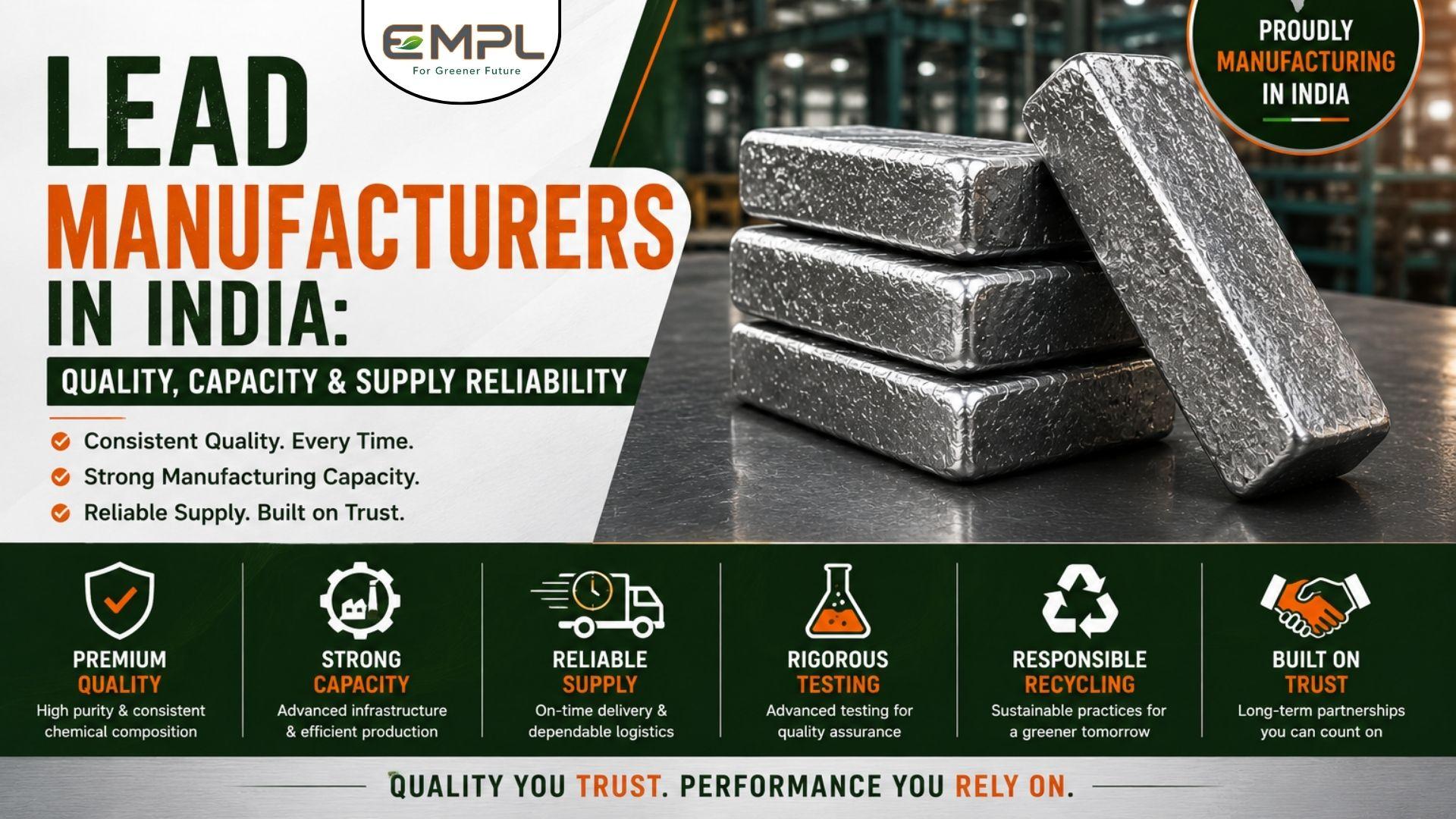
India's industrial and manufacturing sectors depend on a steady supply of metals for everything from battery manufacturing and automotive components to specialized industrial applications. Among these materials, lead and lead alloys continue to play an important role because of their specific physical, chemical and application-related properties.
However, for industrial buyers, choosing a lead manufacturer in India is not simply about finding the lowest price or the highest stated purity.
The real question is:
Can the manufacturer consistently deliver the right material, in the right specification, at the right time and in the required quantity?
This is where quality, manufacturing capacity and supply reliability become critical.
India has a growing ecosystem of primary and secondary lead producers, recyclers and lead-alloy manufacturers. Industry sources indicate that refined lead and lead alloys represent the major portions of lead demand, with lead manufacturers supplying products ranging from refined lead and alloys to oxides and other lead forms.
For industrial buyers, understanding what separates a capable lead manufacturer from an ordinary supplier can help build a more reliable and efficient procurement strategy.
What Does a Lead Manufacturer Do?
A lead manufacturer is responsible for converting suitable raw materials or recovered lead-bearing materials into usable lead products and alloys that meet defined industrial specifications.
Depending on the manufacturer's operations, this can involve:
- Raw material sourcing
- Scrap collection and segregation
- Battery breaking and separation
- Smelting
- Refining
- Alloying
- Chemical analysis
- Casting
- Quality inspection
- Packaging
- Dispatch and logistics
Modern secondary lead manufacturing can therefore be closely connected with recycling and circular material recovery.
For example, Pilot Industries describes a process involving battery breaking and separation, rotary furnace operations, refining, alloying, casting and OES spectrometry for its lead and lead alloy production.
This illustrates an important point for industrial buyers:
The quality of the finished lead depends on the control maintained throughout the manufacturing process—not just the final casting stage.
Why Quality Matters When Choosing a Lead Manufacturer
For industrial manufacturing, raw material quality directly influences production consistency.
A manufacturer may have a large production capacity, but if the material specification varies from batch to batch, the buyer may face challenges further down the production line.
When evaluating a lead supplier in India, buyers should therefore look at factors such as:
- Lead purity
- Chemical composition
- Impurity levels
- Alloy composition
- Batch consistency
- Testing procedures
- Quality documentation
- Product traceability
For example, some Indian lead manufacturers publicly specify refined lead purity levels around 99.97% or higher, while others offer customized alloy compositions for specific industrial applications.
The important takeaway is that purity should not be considered in isolation.
A buyer should evaluate whether the supplied material meets the exact technical requirements of the intended application.
Pure Lead vs Lead Alloys
One of the first decisions an industrial buyer needs to make is whether the application requires pure lead or a lead alloy.
Pure Lead
Pure or refined lead is used where the characteristics of relatively high-purity lead are required.
Applications can include areas such as:
- Lead-acid battery manufacturing
- Radiation shielding
- Specialized industrial components
- Chemical applications
- Certain cable and electrical applications
Lead Alloys
Lead alloys contain controlled additions of other elements to modify the material's properties.
Common lead alloy systems include:
- Lead-antimony
- Lead-calcium
- Lead-tin
- Lead-selenium
- Lead-copper
Industry data also identifies lead-calcium, lead-antimony-selenium, lead-antimony, lead-copper and lead-tin among commonly used lead alloys.
The right choice depends on the product design, manufacturing process and final application.
Therefore, a good lead alloy manufacturer should be able to understand the customer's technical requirements rather than simply offering a standard grade.
Manufacturing Capacity Matters
Quality is essential—but quality alone does not guarantee reliable supply.
Imagine a manufacturer requiring a consistent quantity of lead every month. If its supplier cannot maintain production volumes during periods of higher demand, the buyer may experience:
- Production delays
- Emergency procurement
- Higher transportation costs
- Inventory shortages
- Missed delivery commitments
- Increased operational uncertainty
This makes manufacturing capacity an important supplier-selection criterion.
Indian lead manufacturers operate across a wide range of capacities. For example, NILE reports a combined annual capacity of 107,000 tonnes across two secondary lead recycling plants, while POCL reports 132,000 tonnes per year of finished-goods capacity.
These examples demonstrate why buyers should understand not only what a supplier produces, but also whether its production infrastructure can support the buyer's expected demand.
Why Capacity Is More Than a Number
A manufacturer's stated annual capacity does not automatically guarantee that every buyer will receive material whenever required.
Industrial buyers should also consider:
Production Planning
Can the manufacturer plan production around recurring customer requirements?
Inventory Management
Does the supplier maintain adequate finished-goods or raw-material inventory?
Scalability
Can the manufacturer handle increased demand when required?
Multiple Production Facilities
Does the company have more than one manufacturing location or production line?
Logistics
Can finished products be transported efficiently to the customer's location?
Therefore, capacity should be evaluated as part of the entire supply capability, not as a standalone number.
Supply Reliability Can Reduce Manufacturing Downtime
A manufacturing facility can have excellent machinery, trained employees and strong production planning—but still face downtime if essential raw materials do not arrive on schedule.
This is why reliable supply is an important part of industrial procurement.
A dependable lead supplier should ideally provide:
Consistent Quality + Consistent Quantity + Consistent Delivery
When these three factors work together, manufacturers can maintain better control over their own production schedules.
A reliable supplier relationship can also reduce the need for emergency sourcing, which can be particularly important for industries operating continuous or high-volume manufacturing processes.
Also Read: 7 Factors to Consider Before Choosing an Industrial Metal Supplier
Batch-to-Batch Consistency Is Critical
For industrial manufacturers, receiving one good batch is not enough.
The material needs to remain consistent over repeated deliveries.
Suppose a manufacturer purchases a particular lead alloy because it works well within its production process.
If the alloy composition changes significantly in the next shipment, the manufacturer may have to:
- Adjust its process
- Conduct additional testing
- Hold the incoming material
- Investigate quality deviations
- Risk product inconsistency
This is why batch consistency should be one of the first questions asked when selecting a lead manufacturer.
Buyers should ask:
Can you maintain the agreed chemical composition across recurring orders?
Testing and Quality Control
Quality control should be built into the manufacturing process.
Depending on the product and application, manufacturers may use analytical and testing systems to evaluate:
- Lead purity
- Alloying elements
- Impurities
- Chemical composition
- Product specifications
Some Indian manufacturers specifically highlight laboratory testing and analytical equipment as part of their production infrastructure. NILE, for example, states that its recycling plants include testing facilities, while Pilot Industries identifies OES spectrometry within its lead manufacturing process.
For industrial buyers, this provides an important evaluation point:
Do not simply ask what purity the supplier claims. Ask how that purity and composition are verified.
Recycling and Secondary Lead Manufacturing
A significant part of India's lead manufacturing ecosystem is connected to recycling.
Used lead-acid batteries and other lead-bearing scrap can become valuable sources of secondary lead when processed through appropriate recycling and refining systems.
The recycling value chain can broadly be represented as:
Used Lead-Bearing Material
↓
Collection & Segregation
↓
Processing & Smelting
↓
Refining
↓
Quality Testing
↓
Pure Lead / Lead Alloys
↓
Industrial Applications
This creates a circular flow of material and allows recovered lead to return to industrial use.
India's government has also been working toward a more structured non-ferrous metal recycling ecosystem. In May 2025, the Ministry of Mines launched a dedicated non-ferrous metal recycling website and stakeholder portal covering materials including lead, with the stated objective of supporting a structured, transparent and sustainable recycling ecosystem.
For industrial buyers, this means responsible recycling is becoming increasingly relevant alongside conventional quality and supply considerations.
Why Responsible Manufacturing Matters
Today's industrial buyers are increasingly evaluating suppliers on more than price and product availability.
They may also consider:
- Resource efficiency
- Recycling practices
- Environmental responsibility
- Process control
- Waste management
- Regulatory compliance
- Long-term sustainability
For lead manufacturers, responsible recycling can be particularly important because much of the secondary lead supply chain involves recovery of lead-bearing materials.
A manufacturer that combines recycling, refining, quality control and responsible production can potentially provide both material value and supply-chain benefits.
Also Read: Why Recycled Metals Are the Future of Manufacturing
How to Evaluate Lead Manufacturers in India
Before selecting a long-term supplier, industrial buyers should consider the following factors.
1. Product Quality
Does the supplier consistently meet the required purity and chemical composition?
2. Manufacturing Capability
Does the manufacturer have suitable equipment, refining systems and production infrastructure?
3. Production Capacity
Can the supplier support your current requirements and potential future growth?
4. Quality Testing
Does the manufacturer have appropriate testing and analytical capabilities?
5. Batch Consistency
Can the same specification be maintained across multiple production batches?
6. Delivery Reliability
Does the supplier have a dependable logistics and dispatch system?
7. Technical Support
Can the supplier understand and respond to application-specific requirements?
8. Custom Alloy Capability
If you require a specific alloy composition, can the manufacturer produce it consistently?
9. Documentation
Can the supplier provide the required quality and material documentation?
10. Sustainability
Does the manufacturer demonstrate responsible recycling and resource-management practices?
Lead Manufacturer vs Lead Trader: What's the Difference?
Industrial buyers should also understand the difference between purchasing directly from a manufacturer and purchasing through a trader or intermediary.
A trader can provide valuable sourcing and distribution services, but a direct manufacturer may offer greater visibility into:
- Manufacturing processes
- Production capacity
- Quality systems
- Material composition
- Customization
- Production planning
For recurring industrial requirements, direct engagement with a capable lead manufacturer in India can therefore provide advantages in terms of technical communication and supply planning.
However, the right choice ultimately depends on the buyer's requirements, order volumes and procurement strategy.
Why Long-Term Supplier Relationships Matter
A supplier relationship becomes more valuable when both parties understand each other's requirements.
Over time, a manufacturer can gain a better understanding of:
- Monthly material consumption
- Required specifications
- Delivery schedules
- Packaging preferences
- Forecasted demand
- Quality expectations
This allows both the buyer and supplier to plan more effectively.
Instead of treating every purchase as an individual transaction, the relationship becomes a long-term industrial supply partnership.
The Right Lead Manufacturer Supports More Than Procurement
A capable lead manufacturer can become an important part of a company's overall manufacturing strategy.
The right supplier can help support:
Production Continuity
Reliable material availability reduces the risk of avoidable interruptions.
Quality Consistency
Stable material specifications support stable manufacturing.
Cost Control
Predictable supply can reduce emergency procurement and process-related costs.
Production Planning
Reliable delivery allows manufacturers to plan more confidently.
Product Development
Technical collaboration can help with application-specific material requirements.
Sustainability Goals
Recycled and responsibly processed materials can support circular manufacturing objectives.
Also Read: How to Choose the Right Alloy for Your Industry | Industrial Alloy Guide
EMPL: Quality-Focused Lead & Alloy Manufacturing
For companies looking for a dependable lead manufacturer in India, the focus should ultimately be on the combination of quality, manufacturing capability and supply reliability.
At EEYA Metal & Alloys Pvt. Ltd. (EMPL), our focus is on lead, tin, antimony and lead alloys, with an emphasis on quality-focused manufacturing, responsible recycling and dependable industrial supply.
For industrial customers, the objective is straightforward:
Consistent material. Reliable supply. Long-term value.
Rather than viewing lead simply as a commodity, manufacturers should consider it an important input into their own production systems.
That makes supplier capability and reliability critical.
Final Thoughts
Choosing among lead manufacturers in India requires a broader evaluation than simply comparing quotations.
Industrial buyers should assess:
Quality — Does the material meet the required specification?
Capacity — Can the manufacturer support the required volume?
Consistency — Can the same quality be maintained across batches?
Reliability — Can the material arrive when required?
Testing — Is the product properly verified?
Responsibility — Is the material produced through responsible manufacturing and recycling practices?
The best supplier is not necessarily the one offering the lowest price.
It is the manufacturer capable of providing the right material, at the right quality, in the right quantity and at the right time.
For industries that depend on lead and lead alloys, that combination can make a significant difference to production efficiency, product quality and long-term supply-chain stability.
Quality builds confidence. Capacity builds continuity. Reliability builds partnerships.


