


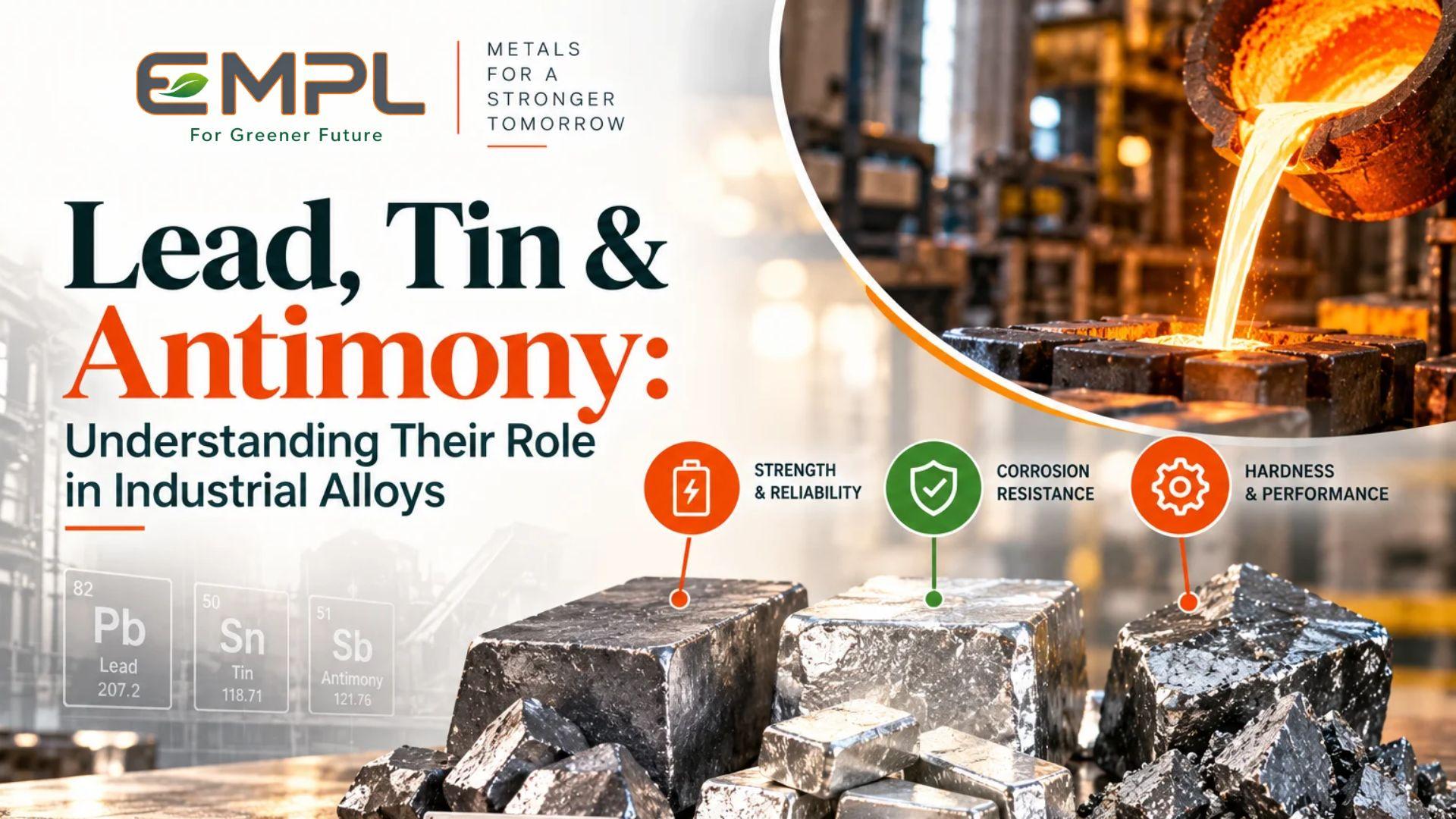
Industrial alloys play a vital role in modern manufacturing by helping businesses achieve the right balance of strength, durability, corrosion resistance, and functional performance. Among the metals used in several industrial applications, lead, tin, and antimony are important because of their distinct properties and their ability to contribute to specific alloy characteristics.
Although these metals serve different purposes, combining them in carefully controlled proportions can help manufacturers develop materials suited to particular operating conditions and product requirements. Understanding their individual properties is essential for selecting the right alloy, maintaining consistent quality, and improving manufacturing efficiency.
In this article, we explore the roles of lead, tin, and antimony in industrial alloys, their key characteristics, common applications, and the factors businesses should consider when sourcing these materials.
Also Read: Top Industrial Uses of Lead, Tin, and Antimony – Complete Guide
1. Understanding Lead in Industrial Alloys
Lead is a dense, soft metal known for its excellent malleability, corrosion resistance in many environments, and useful electrochemical properties. These characteristics make it relevant to several industrial applications, particularly where controlled material composition and reliable performance are important.
Key Properties of Lead
-
High density: Useful in applications requiring substantial mass or weight within a compact volume.
-
Malleability: Can be shaped and processed for suitable industrial applications.
-
Corrosion resistance: Performs well in certain chemical environments, depending on the conditions.
-
Electrochemical properties: Makes lead an important material in lead-acid battery systems.
-
Alloy compatibility: Can be combined with other metals to modify selected material properties.
Role of Lead in Alloys
Lead often serves as the primary metal in lead-based alloys. Its characteristics provide the foundation, while additional elements help adjust properties such as hardness, mechanical strength, and performance under particular service conditions.
Lead-based materials are used in applications including lead-acid batteries, cable sheathing, radiation shielding, and specialised industrial components, subject to applicable technical and safety requirements.
For manufacturers, the quality of lead matters. Consistent purity and controlled impurity levels help ensure that the material meets the specifications required for the intended application.
2. Understanding Tin and Its Contribution to Alloys
Tin is a silvery metal valued for its corrosion resistance, relatively low melting point, and usefulness in soldering and alloy production. It can improve the suitability of a material for specific joining, coating, and manufacturing processes.
Key Properties of Tin
-
Corrosion resistance: Helps protect materials in appropriate applications and environments.
-
Low melting point: Makes tin useful in soldering and other processes that require relatively low processing temperatures.
-
Alloying versatility: Combines with different metals to produce materials with tailored characteristics.
-
Wettability in soldering: Supports the formation of suitable joints when the solder formulation and process are correctly selected.
Role of Tin in Industrial Alloys
Tin is widely associated with solder alloys, tin-based bearing materials, bronze, and protective coatings. In lead-containing alloys, tin may be added to adjust properties required by a specific manufacturing process or end use.
Its exact contribution depends on the complete alloy composition, processing conditions, and intended application. Tin content alone does not determine whether an alloy will deliver the desired performance.
For industrial buyers, the key consideration is whether the tin grade and composition are appropriate for the product specification. Reliable sourcing and material documentation help reduce the risk of inconsistency during production.
3. Understanding Antimony and Its Role in Lead Alloys
Antimony is a metalloid that can significantly influence the properties of certain metal alloys. It is particularly relevant to specific lead-based alloy formulations, where controlled additions can increase hardness and strength compared with unalloyed lead.
Key Properties of Antimony
-
Hardening effect: Can increase the hardness of lead-based alloys.
-
Strength modification: Helps adjust mechanical properties when used in suitable proportions.
-
Composition control: Requires careful measurement to achieve the required alloy specification.
-
Application-specific performance: Its contribution depends on the other elements present and the manufacturing process.
Role of Antimony in Industrial Alloys
Antimony is used in certain lead-antimony alloys, including some applications involving lead-acid battery grids and specialised industrial products. The proportion of antimony affects the resulting alloy's properties, so it must be selected according to the intended use.
Adding more antimony does not automatically produce a better alloy. Excessive or unsuitable concentrations can change material behaviour in ways that may not meet the application's requirements.
This is why manufacturers need dependable alloy composition, appropriate testing, and clear technical specifications when purchasing lead-antimony materials.
4. How Lead, Tin, and Antimony Work Together
Lead, tin, and antimony contribute different characteristics to alloy systems. Their usefulness depends on how the elements interact within a defined composition.
| Metal | Primary contribution in relevant alloy systems | Commonly associated applications |
|---|---|---|
| Lead | Density, formability, and a base material for lead-based alloys | Lead-acid batteries, shielding, cable sheathing |
| Tin | Corrosion resistance and useful processing or joining characteristics | Soldering, coatings, bearing materials, selected lead-containing alloys |
| Antimony | Increased hardness and strength in suitable lead-based formulations | Certain battery grids and specialised lead alloys |
The right formulation depends on the intended application. For example, a battery manufacturer may require a particular lead alloy composition to meet grid-design and service-life requirements, while another industrial application may prioritise different mechanical or processing characteristics.
The objective is not simply to combine metals, but to achieve a controlled composition that meets the end product's technical requirements.
5. Why Alloy Composition Matters in Manufacturing
Even small variations in alloy composition can influence material behaviour. The importance of each element depends on the product, its operating conditions, and the manufacturer's quality requirements.
Several factors make composition control essential:
Consistent Material Properties
Manufacturers need materials that behave predictably from one production batch to another. Uncontrolled variations can affect processing, finished-product performance, and quality assurance.
Process Compatibility
An alloy must be suitable for the manufacturing method being used. Its composition can influence melting behaviour, casting, forming, joining, and other production stages.
Product Reliability
The right alloy specification helps manufacturers achieve the properties required by the finished product. Material selection should therefore be based on documented requirements rather than assumptions about individual metals.
Quality Assurance
Chemical composition analysis and appropriate inspection procedures help verify that the supplied material conforms to the agreed specification.
6. Common Industrial Applications of Lead-Based Alloys
Lead-based alloys are used in selected industries where their specific material properties are required. The exact formulation varies according to technical needs.
Lead-Acid Batteries
Lead and lead-based alloys are important in lead-acid battery components. Alloy composition can influence properties such as grid strength, casting behaviour, and corrosion performance. The appropriate formulation depends on battery design and operating requirements.
Cable Sheathing and Specialised Components
Lead's density and resistance to certain environments have supported its use in cable sheathing and other specialised components. Suitability depends on the application, relevant standards, and environmental considerations.
Soldering and Joining
Tin is an important component in many solder formulations. Lead-containing solders are used in certain specialised or legacy applications, but lead-free alternatives are required or preferred in many markets. Buyers should confirm the applicable regulatory requirements before selecting a solder alloy.
Industrial and Technical Applications
Specific lead alloys may be used where their defined properties suit the engineering requirement. Each application calls for a suitable composition, documented material quality, and appropriate handling controls.
Because lead and some antimony compounds present health and environmental hazards, manufacturers and suppliers must follow applicable occupational safety, environmental, recycling, and waste-management requirements.
7. What Industrial Buyers Should Check Before Sourcing Metal Alloys
Selecting a reliable metal supplier involves more than comparing prices. Buyers should assess whether the material can meet their specifications consistently.
Consider the following factors before placing an order:
-
Required composition: Confirm the percentage or permitted range of each relevant element.
-
Purity and impurity limits: Check whether the material meets the application's chemical requirements.
-
Testing and documentation: Ask for a certificate of analysis or equivalent documentation where applicable.
-
Batch consistency: Confirm that supplied lots are checked against the agreed specifications.
-
Supply reliability: Evaluate the supplier's ability to fulfil orders according to agreed quantities and schedules.
-
Application suitability: Ensure the alloy is appropriate for the intended manufacturing process and end use.
-
Safety and compliance: Verify relevant regulatory, handling, storage, and environmental requirements.
Clear communication between the buyer and supplier helps prevent specification mismatches and reduces the likelihood of avoidable production issues.
8. The Importance of Quality Control in Alloy Manufacturing
Quality control connects the alloy specification with the material actually delivered. It can include incoming-material checks, chemical composition analysis, process monitoring, batch identification, and final inspection, depending on the product and applicable requirements.
For lead, tin, and antimony alloys, composition control is especially important because the concentration of each element can influence the final material's characteristics.
A structured quality process helps manufacturers:
-
Verify compliance with agreed material specifications.
-
Identify composition variations before materials enter production.
-
Maintain better consistency between batches.
-
Improve traceability and documentation.
-
Reduce the risk of rejected material and production disruption.
The appropriate testing method and acceptance criteria should be selected according to the alloy and its intended application.
9. Choosing the Right Alloy for Your Application
There is no single alloy formulation that is best for every industrial requirement. The correct selection depends on the finished product, required properties, manufacturing process, operating environment, and applicable standards.
Before finalising a specification, manufacturers should define their performance requirements and consult relevant technical documentation. Where necessary, they should work with qualified materials specialists to validate the formulation.
A supplier that understands composition requirements, maintains appropriate quality checks, and communicates material specifications clearly can help businesses make more informed procurement decisions.
Also Read: Top Industrial Uses of Lead, Tin, and Antimony – Complete Guide
Conclusion
Lead, tin, and antimony each play distinct roles in industrial metallurgy. Lead provides the base for several lead-based alloy systems, tin contributes useful characteristics in selected alloying and joining applications, and antimony can increase hardness and strength in suitable lead alloys.
Their effectiveness depends on the correct composition, manufacturing process, and application requirements. For industrial buyers, understanding these differences makes it easier to specify suitable materials, evaluate suppliers, and maintain consistent product quality.
At EEYA Metal & Alloys Pvt. Ltd. (EMPL), reliable industrial metal supply begins with understanding material requirements and the importance of consistent quality. When sourcing lead, tin, or specialised alloys, clear specifications and appropriate quality verification are essential steps towards dependable manufacturing.
Looking for reliable industrial metal supply? Visit www.eeyametal.com to learn more about EEYA Metal & Alloys and its metal solutions.


