


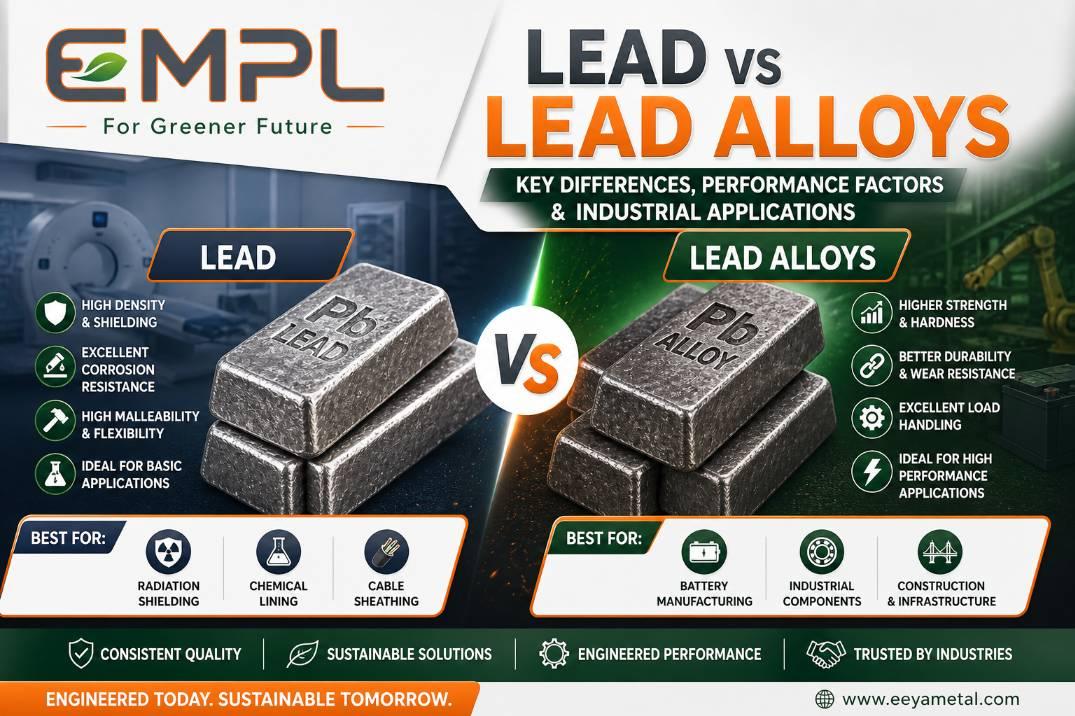
In the non-ferrous metal industry, material selection directly impacts performance, durability, and cost efficiency. Among the most widely used materials, lead and lead alloys continue to play a critical role across sectors like energy storage, construction, and industrial manufacturing.
While both share a common base, the difference between pure lead and engineered lead alloys is significant—and choosing the right one can define the success of your application.
At EEYA Metal & Alloys Pvt. Ltd. (EMPL), we work closely with industries to deliver high-purity lead and precision-engineered alloys tailored for performance and reliability.
Understanding Pure Lead
Lead is a dense, corrosion-resistant, and highly workable metal that has been used for centuries in industrial applications.
🔹 Core Characteristics
-
High density → ideal for shielding
-
Excellent corrosion resistance → performs well in harsh environments
-
Low melting point → easy to process and mold
-
High malleability → suitable for flexible applications
Where Pure Lead is Used
-
Radiation shielding (hospitals, nuclear setups)
-
Chemical storage and lining
-
Cable sheathing
-
Soundproofing and vibration control
👉 However, its low mechanical strength limits its use in high-load environments.
What Makes Lead Alloys Different?
Lead alloys are developed by combining lead with elements like:
-
Antimony
-
Tin
-
Calcium
-
Selenium
This transformation is not just chemical—it’s performance-driven engineering.
🔹 Why Alloys Are Created
To overcome the natural limitations of pure lead by improving:
-
Strength
-
Hardness
-
Fatigue resistance
-
Structural integrity
Lead vs Lead Alloys: The Real Difference
|
Parameter |
Pure Lead |
Lead Alloys |
|
Strength |
Low |
Significantly Higher |
|
Hardness |
Soft |
Enhanced |
|
Durability |
Moderate |
High |
|
Load Handling |
Limited |
Excellent |
|
Flexibility |
Very High |
Controlled |
|
Application Scope |
Basic |
Advanced Industrial |
👉 In simple terms:
Lead is functional. Lead alloys are performance-optimized.
Also Read: How to Choose the Right Metal Supplier for Your Industry Needs
Industrial Applications: Where Each Fits Best
🔹 Pure Lead Applications
Used where flexibility and corrosion resistance matter more than strength:
-
Radiation shielding systems
-
Chemical tanks and linings
-
Roofing and protective layers
🔹 Lead Alloys Applications
1. Battery Manufacturing (Major Use Case)
Lead alloys are the backbone of:
-
Automotive batteries
-
Industrial batteries
-
Renewable energy storage systems
👉 They provide:
✔ Structural strength
✔ Longer cycle life
✔ Better performance under stress
2. Heavy-Duty Industrial Components
-
Bearings
-
Mechanical parts
-
High-load equipment
👉 Alloys reduce wear and increase lifespan
3. Cable & Electrical Industry
-
High-performance cable sheathing
-
Electrical components requiring durability
4. Construction & Infrastructure
-
Pipes
-
Structural sheets
-
Industrial fittings
Why Industries Prefer Lead Alloys Today
Modern industries are shifting towards lead alloys because they:
✔ Improve operational reliability
✔ Reduce maintenance costs
✔ Enhance product lifespan
✔ Perform consistently under demanding conditions
At EEYA Metal & Alloys Pvt. Ltd., we’ve seen a clear trend—clients are prioritizing consistency and strength over basic functionality.
Key Decision Factors: Lead or Lead Alloy?
Choosing between lead and lead alloys depends on:
-
Load requirements
-
Environmental exposure
-
Product lifecycle expectations
-
Cost vs performance balance
👉 Use Pure Lead when flexibility and corrosion resistance are primary
👉 Use Lead Alloys when strength, durability, and performance are critical
Also Read: Non-Ferrous Metal Recycling Explained
How EEYA Metal (EMPL) Ensures Quality & Consistency
At EEYA Metal & Alloys Pvt. Ltd. (EMPL), quality is not an afterthought—it’s built into every stage:
✔ High-purity raw material sourcing
✔ Controlled alloy composition
✔ Advanced recycling and refining processes
✔ Strict quality testing protocols
✔ Batch-to-batch consistency
Our focus is simple:
👉 Deliver metals that perform exactly as expected—every time
Conclusion
The choice between lead and lead alloys is not just technical—it’s strategic.
While pure lead offers flexibility and resistance, lead alloys unlock performance, strength, and long-term reliability, making them essential for modern industrial applications.
For businesses looking to optimize efficiency and durability, the right material choice makes all the difference.
About EEYA Metal & Alloys Pvt. Ltd. (EMPL)
We specialize in delivering high-quality non-ferrous metals and advanced recycling solutions, helping industries achieve consistency, performance, and sustainability.


