


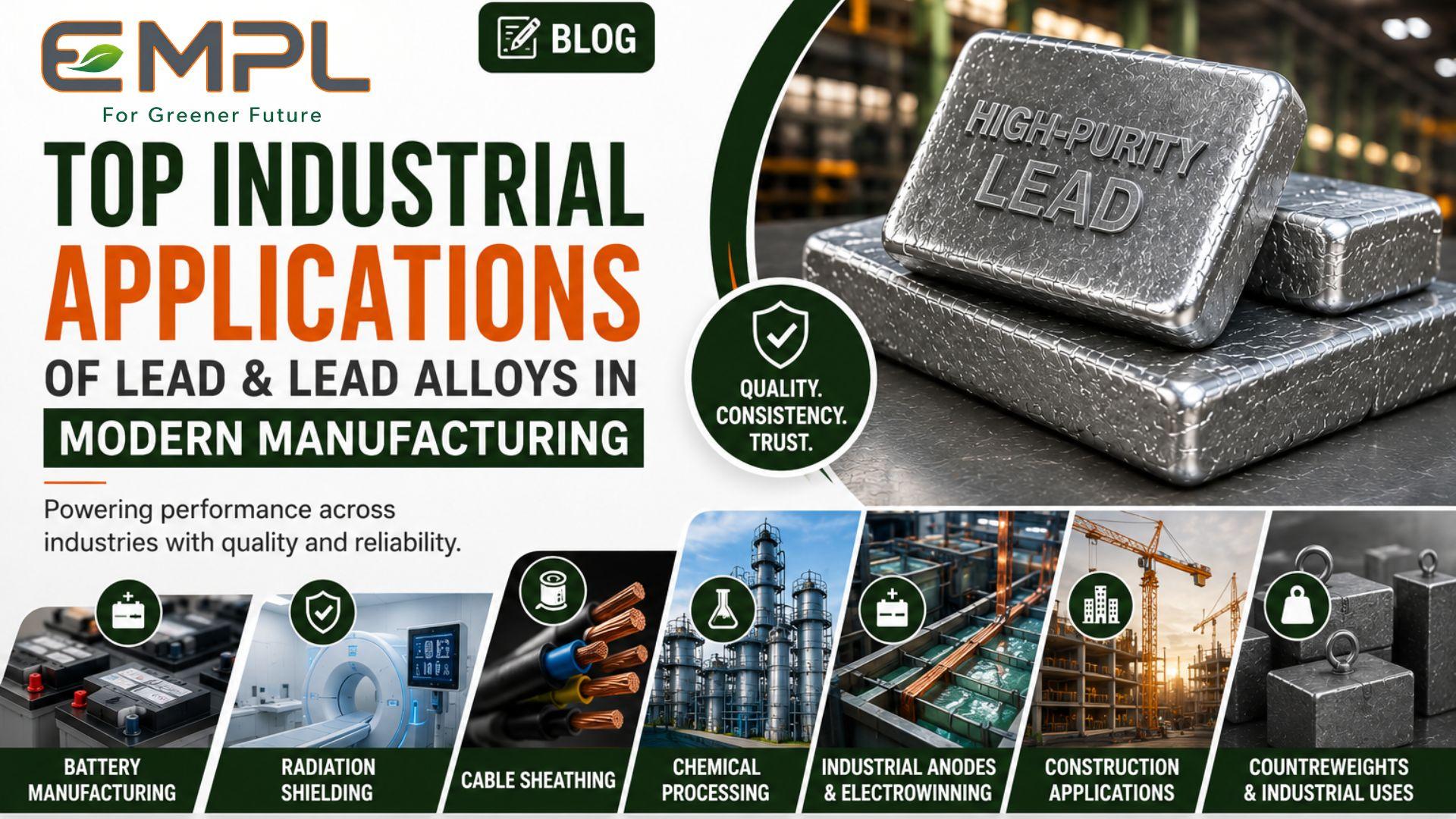
Lead has been used in industrial manufacturing for centuries, but its importance has evolved with modern engineering and manufacturing requirements. Today, lead and lead alloys continue to serve specialized applications where properties such as high density, corrosion resistance, low melting point, malleability, and controlled electrochemical behaviour are valuable.
From lead-acid battery manufacturing and cable sheathing to radiation shielding, chemical processing and industrial anodes, lead-based materials remain an important part of several manufacturing supply chains. Different alloying elements—including antimony, calcium, tin, silver, copper and tellurium—are used to modify lead's properties for specific applications.
For manufacturers, however, the application is only one part of the equation. Consistent chemical composition, purity, quality control and reliable supply from an experienced lead supplier are equally important.
What Makes Lead Useful in Industrial Manufacturing?
Pure lead has a unique combination of physical and chemical properties that makes it suitable for specific industrial applications.
Some of its important characteristics include:
- High density
- Excellent corrosion resistance in many environments
- Good malleability and ductility
- Low melting point compared with many industrial metals
- Ability to absorb X-rays and gamma radiation
- Useful electrochemical characteristics
- Ability to form a wide range of alloys
- Good recyclability
However, pure lead has relatively poor mechanical strength. Alloying can improve its performance for specific applications. For example, lead-antimony, lead-calcium, lead-tin, lead-silver and lead-tellurium alloys are used for different industrial purposes.
This is why lead alloy manufacturers play an important role in supplying application-specific materials.
1. Lead-Acid Battery Manufacturing
The largest and most established industrial application of lead remains lead-acid battery manufacturing.
Lead and lead alloys are used in components including:
- Battery grids
- Posts
- Connectors
- Terminals
- Other current-carrying components
Lead-antimony and lead-calcium-based alloys are among the important alloy systems used in battery manufacturing. Lead-calcium alloys have increasingly been used in applications such as sealed batteries because of their low hydrogen-evolution characteristics.
Lead-acid batteries continue to serve applications such as:
- Automotive batteries
- Inverter systems
- Backup power
- Telecommunications
- Industrial power systems
- Stationary energy storage
Why material quality matters
Battery manufacturing requires controlled material chemistry. Variations in alloy composition can influence processing and the performance characteristics of battery components.
Therefore, battery manufacturers often require a reliable lead supplier capable of maintaining consistent chemical composition and batch quality.
2. Radiation Shielding
Another important application of lead is radiation shielding.
Lead's high density and high atomic number make it effective for attenuating X-rays and gamma radiation. This makes lead useful in specialized shielding applications across medical, industrial and research environments.
Applications can include:
- X-ray rooms
- Medical imaging facilities
- Radiation-shielding barriers
- Industrial radiography
- Nuclear facilities
- Laboratory equipment
Lead may be supplied in different forms depending on the application, including sheets, blocks and specialized fabricated components.
For radiation-shielding manufacturers, the material needs to meet the required specifications for the intended shielding application.
3. Cable Sheathing
Lead and lead alloys have historically been used as protective sheathing for cables.
The material can provide protection against environmental exposure, moisture and certain corrosive conditions. Lead alloys can also be engineered to improve characteristics required for cable-sheathing applications.
Applications include:
- Power cables
- Communication cables
- Underground cables
- Specialty industrial cables
- Certain marine and harsh-environment applications
Lead-antimony, lead-calcium and other alloy systems have been associated with cable-sheathing applications.
For cable manufacturers, consistent alloy chemistry is important because the material must perform reliably during processing and throughout its service life.
4. Chemical Processing Equipment
Lead's resistance to corrosion in certain chemical environments has made it useful in chemical-processing applications.
Lead and lead alloys can be used for:
- Tank linings
- Pipes
- Tubes
- Chemical equipment
- Acid-resistant linings
- Pumps and valves
- Heating and cooling components
Lead-antimony alloys, for example, have been used in chemical plant applications, while lead-copper materials have been used in sheets, pipes, cable sheathing and tank linings.
The exact material selection depends on the chemical environment, operating temperature and required service conditions.
5. Industrial Anodes & Electrowinning
Lead alloys are also important in electrochemical and metal-recovery applications.
Lead-based anodes can be used in electrowinning and related processes where they need to withstand demanding electrochemical environments.
Lead-calcium-tin and lead-silver alloys are among the alloy systems used for anode applications.
These materials are relevant to industries involved in:
- Metal extraction
- Metal refining
- Electrowinning
- Hydrometallurgical processing
- Industrial electrochemistry
For these applications, alloy chemistry can have a direct influence on anode performance and service life.
6. Soldering & Joining Applications
Lead-tin alloys have traditionally been important solder materials because of their useful melting and joining characteristics.
Depending on the application and applicable regulations, lead-containing solders may be used in specialized industrial joining processes.
Lead-tin alloys are also associated with applications involving:
- Industrial soldering
- Specialized joining
- Certain electronic applications
- Automotive-related applications
- Heat exchangers
- Specialized metal fabrication
Lead-tin alloys can contain different proportions of tin depending on the required application.
7. Construction & Architectural Applications
Lead has also been used in specialized construction applications because of its:
- High density
- Malleability
- Corrosion resistance
- Ability to form sheets
- Radiation-shielding characteristics
Applications can include:
- Roofing materials
- Flashing
- Building sheets
- Pipe and lining applications
- Specialized radiation-shielding structures
Lead-copper materials, for example, have been associated with lead sheet and construction applications.
The use of lead in construction must, of course, comply with applicable health, safety and environmental regulations.
8. Counterweights & Ballast
One of lead's most distinctive physical properties is its high density.
This makes it useful when manufacturers need substantial weight within a relatively compact volume.
Potential applications include:
- Industrial counterweights
- Ballast
- Specialized machinery
- Equipment balancing
- Vibration-control applications
- Certain fabricated industrial components
Because lead provides high mass without requiring the volume of many alternative materials, it can be useful for specialized engineering applications.
9. Bearings & Specialized Components
Certain lead-based alloys have also been developed for bearing and specialized mechanical applications.
Lead-antimony-tin systems, for example, have been associated with bearing materials.
Lead-based materials can be selected where particular combinations of:
- Low friction
- Conformability
- Corrosion resistance
- Machinability
- Controlled alloy properties
are required.
These applications demonstrate why selecting the right lead alloy is often more important than simply selecting lead based on purity alone.
10. Industrial Sheets, Pipes & Linings
Lead sheets, pipes and fabricated products have been used in several industrial environments where the material's density, malleability and corrosion resistance offer practical advantages.
Applications can include:
- Chemical plant linings
- Industrial tanks
- Pipes
- Acid-resistant components
- Roofing sheets
- Cable protection
- Specialized fabricated products
Different alloy compositions may be selected depending on the required mechanical and chemical characteristics.
Lead vs Lead Alloys: Why Does Alloy Composition Matter?
One of the biggest considerations in industrial lead procurement is understanding the difference between pure lead and lead alloys.
Pure lead provides excellent density, malleability and radiation attenuation, but its mechanical strength is relatively low.
Adding controlled quantities of other elements can modify its properties.
| Lead Alloy | Typical Industrial Applications |
|---|---|
| Lead-Antimony | Batteries, cable sheathing, anodes, chemical equipment |
| Lead-Calcium | Automotive & sealed batteries, anodes, cable applications |
| Lead-Tin | Soldering, specialized joining, coatings |
| Lead-Copper | Sheets, pipes, linings, cable sheathing |
| Lead-Silver | Anodes, specialized solders |
| Lead-Tellurium | Radiation-related applications and specialized cable alloys |
The exact composition should always be selected according to the technical specification and intended application rather than assuming that one alloy is suitable for every purpose.
Why Manufacturers Need a Reliable Lead Supplier
Industrial manufacturers don't simply purchase metal—they purchase consistency.
A variation in material chemistry can affect production processes, casting behaviour, component performance and quality control.
When evaluating a lead supplier in India, manufacturers should consider:
1. Purity & Chemical Composition
The supplier should be able to consistently meet the required specifications.
2. Batch-to-Batch Consistency
Stable chemistry helps manufacturers maintain predictable production.
3. Quality Testing
Laboratory analysis and quality-control systems provide greater confidence in the supplied material.
4. Production Capacity
The supplier should have sufficient capacity to support regular industrial requirements.
5. Reliable Delivery
Manufacturing plants cannot afford frequent interruptions caused by raw-material shortages.
6. Product & Alloy Range
An experienced lead alloy manufacturer should understand the requirements of different industrial applications.
7. Traceability & Documentation
Proper documentation helps manufacturers maintain procurement and quality records.
8. Responsible Recycling
For recycled lead products, responsible collection, refining and quality control are important parts of building a reliable circular supply chain.
The Role of Recycled Lead in Modern Manufacturing
Lead is particularly suited to circular material systems because recovered lead can be refined and returned to industrial applications.
A typical recycling chain can be represented as:
Lead-Bearing Scrap → Collection → Processing → Refining → Quality Testing → High-Purity Lead / Lead Alloy → Industrial Manufacturing
Responsible recycling allows valuable lead to remain within the material cycle instead of becoming waste.
For industrial buyers, however, recycled material must still meet the required technical specifications. The emphasis should therefore be on refining quality, purity and consistency, not simply on whether the material is recycled.
Choosing the Right Lead Manufacturer in India
For businesses purchasing lead regularly, the supplier's manufacturing and quality capabilities can have a direct impact on production.
A reliable lead manufacturer in India should ideally combine:
Quality + Consistency + Technical Capability + Reliable Supply + Responsible Recycling
Before placing a long-term order, manufacturers should clearly define:
- Required lead purity
- Alloy composition
- Physical form
- Quantity requirements
- Packaging requirements
- Quality documentation
- Delivery schedule
- Applicable industry standards
This helps both the buyer and supplier establish clear expectations.
Why Lead & Lead Alloys Remain Relevant
Despite the development of newer materials, lead continues to occupy important positions in specific industrial applications because its combination of properties is difficult to replicate economically in every use case.
Its high density, corrosion resistance, malleability, electrochemical behaviour and ability to form specialized alloys make it valuable in applications ranging from batteries and radiation shielding to chemical processing, cable protection and industrial anodes.
The key is not simply using lead—it is using the right grade and alloy for the right application.
Conclusion
Lead and lead alloys continue to play an important role in modern manufacturing.
From the battery industry to chemical processing, cable manufacturing, radiation shielding, electrowinning, construction and specialized engineering applications, manufacturers depend on lead-based materials for specific performance characteristics.
For these industries, choosing an experienced lead supplier is critical. Consistent chemistry, controlled purity, reliable quality testing and dependable supply can help manufacturers maintain production efficiency and product quality.
At EEYA Metal & Alloys Pvt. Ltd. (EMPL), the focus is on delivering quality lead and lead alloy materials while supporting responsible recycling and sustainable industrial manufacturing.
The right metal doesn't just become part of a product—it becomes part of its performance.


