


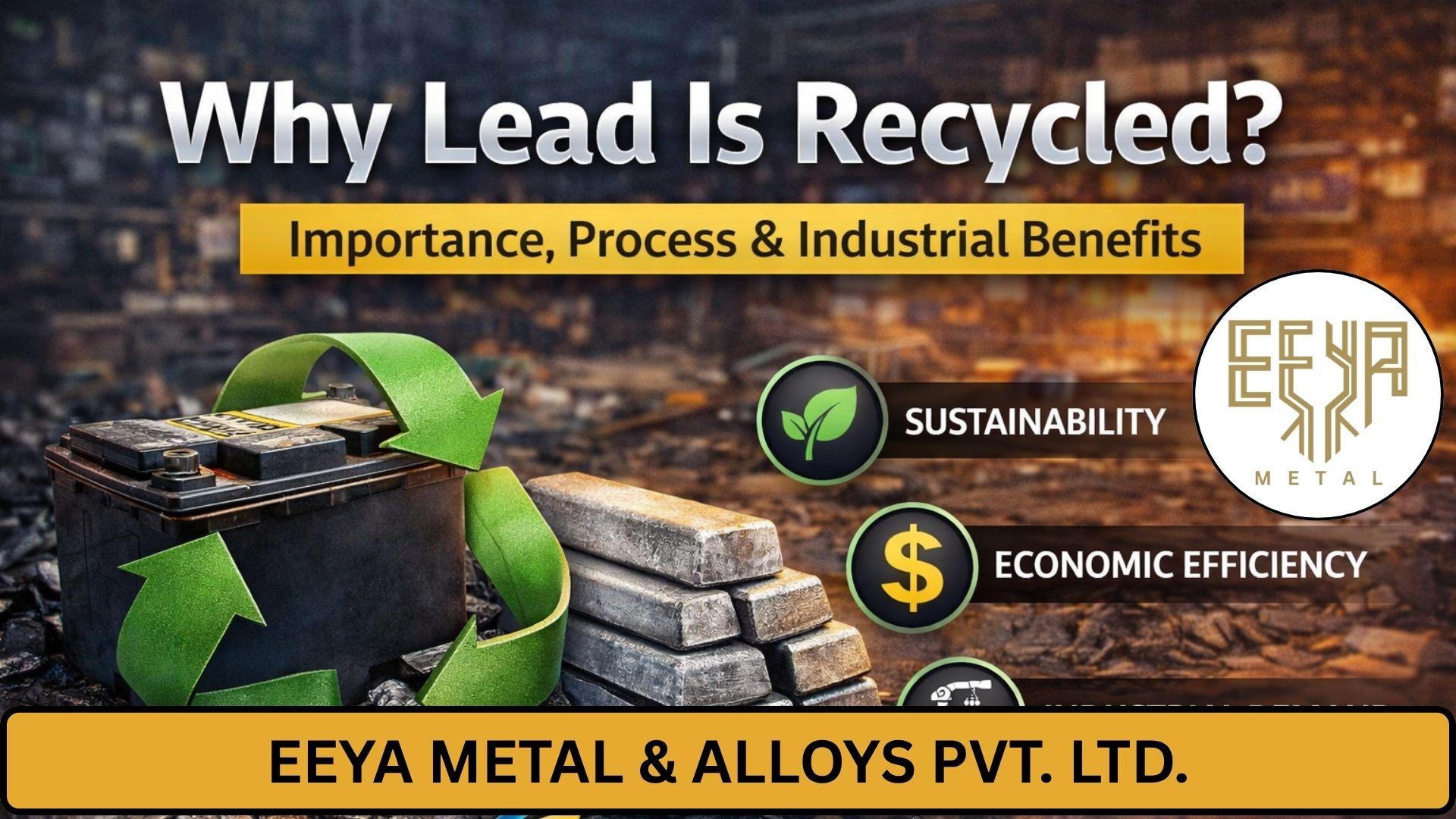
Lead is one of the most widely recycled metals in the world. Unlike many other materials, lead can be recycled repeatedly without losing its chemical or physical properties, making it extremely valuable for sustainable industrial production.
From automotive batteries and industrial batteries to radiation shielding and cable sheathing, lead plays a critical role across multiple industries. Because of its widespread use and environmental considerations, recycling lead has become an essential practice for manufacturers and recycling companies worldwide.
In this blog, we explore why lead is recycled, how the lead recycling process works, and why industries prefer recycled lead over newly mined lead.
Why Lead Is Recycled
Lead recycling is driven by three major factors:
-
Environmental sustainability
-
Economic efficiency
-
Continuous industrial demand
Let’s explore each in detail.
1. Lead Is 100% Recyclable
One of the biggest advantages of lead is that it can be recycled indefinitely without degrading in quality.
This means recycled lead performs almost exactly like newly mined lead.
Key advantages:
-
Maintains chemical purity
-
Retains strength and density
-
Suitable for high-performance industrial applications
Because of this unique property, lead is considered one of the most sustainable industrial metals.
2. Lead Recycling Reduces Environmental Impact
Mining new lead requires extensive extraction processes that can cause:
-
Land degradation
-
Energy consumption
-
Air and water pollution
Recycling lead significantly reduces these environmental impacts.
Benefits include:
-
Lower carbon emissions
-
Reduced mining activity
-
Reduced industrial waste
-
Conservation of natural resources
According to industry studies, recycling lead uses significantly less energy compared to producing lead from ore.
This makes lead recycling an essential component of the circular economy in metal manufacturing.
3. Huge Demand from Battery Manufacturing
One of the biggest reasons lead is recycled is the global demand for lead-acid batteries.
Lead-acid batteries are widely used in:
-
Automobiles
-
UPS systems
-
Telecom infrastructure
-
Solar power storage
-
Industrial backup systems
Since these batteries contain a large amount of lead, recycling used batteries helps recover valuable lead that can be reused in new battery production.
In fact, over 80% of global lead production is used in batteries.
4. Recycling Saves Production Costs
Producing lead from mined ore is expensive due to:
-
Mining operations
-
Transportation
-
Refining processes
-
Environmental compliance
Recycling lead reduces these costs significantly.
Advantages include:
-
Lower raw material costs
-
Reduced energy consumption
-
Faster production cycles
For manufacturers, recycled lead offers a cost-effective alternative without compromising quality.
Also Read: What is Non-Ferrous Metal Recycling?
The Lead Recycling Process
Lead recycling involves several key steps to recover usable metal from scrap materials such as used batteries.
Step 1: Collection of Lead Scrap
Lead scrap is collected from:
-
Used lead-acid batteries
-
Industrial scrap
-
Manufacturing waste
-
Cable sheathing materials
These materials are then transported to recycling facilities.
Step 2: Breaking and Separation
Used batteries are broken down to separate different components:
-
Lead plates
-
Plastic casing
-
Electrolyte solution
Each material is processed separately.
Step 3: Smelting
The extracted lead components are melted in high-temperature furnaces.
During this stage:
-
Impurities are removed
-
Slag is separated
-
Metal is purified
Step 4: Refining
The molten lead undergoes a refining process to achieve high purity levels suitable for industrial applications.
This stage ensures:
-
Chemical stability
-
High-quality metal output
-
Consistent composition
Step 5: Casting into Lead Ingots
Finally, the purified lead is cast into lead ingots or alloy forms that can be used by manufacturers.
These ingots are then supplied to industries for further use.
Industrial Applications of Recycled Lead
Recycled lead is widely used across multiple sectors.
Major applications include:
Battery Manufacturing
Lead-acid batteries for automotive and industrial systems.
Radiation Shielding
Hospitals and nuclear facilities use lead for protection against radiation.
Cable Sheathing
Lead protects cables from moisture and corrosion.
Alloys Manufacturing
Lead is combined with other metals to produce industrial alloys.
Also Read: Top Industrial Uses of Lead, Tin, and Antimony – Complete Guide
Advantages of Lead Recycling for Industries
Recycling lead provides several long-term benefits for manufacturers and suppliers.
Key benefits include:
✔ Lower production costs
✔ Reduced environmental impact
✔ Sustainable metal supply
✔ High material efficiency
✔ Support for circular economy models
These advantages make lead recycling an essential practice in modern manufacturing.
Role of EEYA Metal & Alloys Pvt. Ltd. in Lead Recycling
Companies like EEYA Metal & Alloys Pvt. Ltd. play an important role in the metal recycling ecosystem.
Through advanced refining and recycling processes, EEYA provides:
-
High-purity lead products
-
Sustainable recycling solutions
-
Reliable supply for industrial applications
By transforming scrap lead into reusable metal, the company supports both industrial growth and environmental responsibility.
The Future of Lead Recycling
As industries focus more on sustainability, ESG goals, and circular economy models, lead recycling will continue to grow.
Future trends include:
-
Increased battery recycling
-
Improved refining technologies
-
Stronger environmental regulations
-
Greater use of recycled metals in manufacturing
These developments will further strengthen the importance of lead recycling in the global metal industry.
Conclusion
Lead recycling is essential for both environmental sustainability and industrial efficiency. Because lead can be recycled indefinitely without losing quality, it remains one of the most valuable metals in the circular economy.
By recycling lead, industries can reduce costs, conserve natural resources, and support sustainable manufacturing practices.
As global demand for batteries and industrial metals continues to grow, lead recycling will remain a key pillar of responsible industrial development.


