


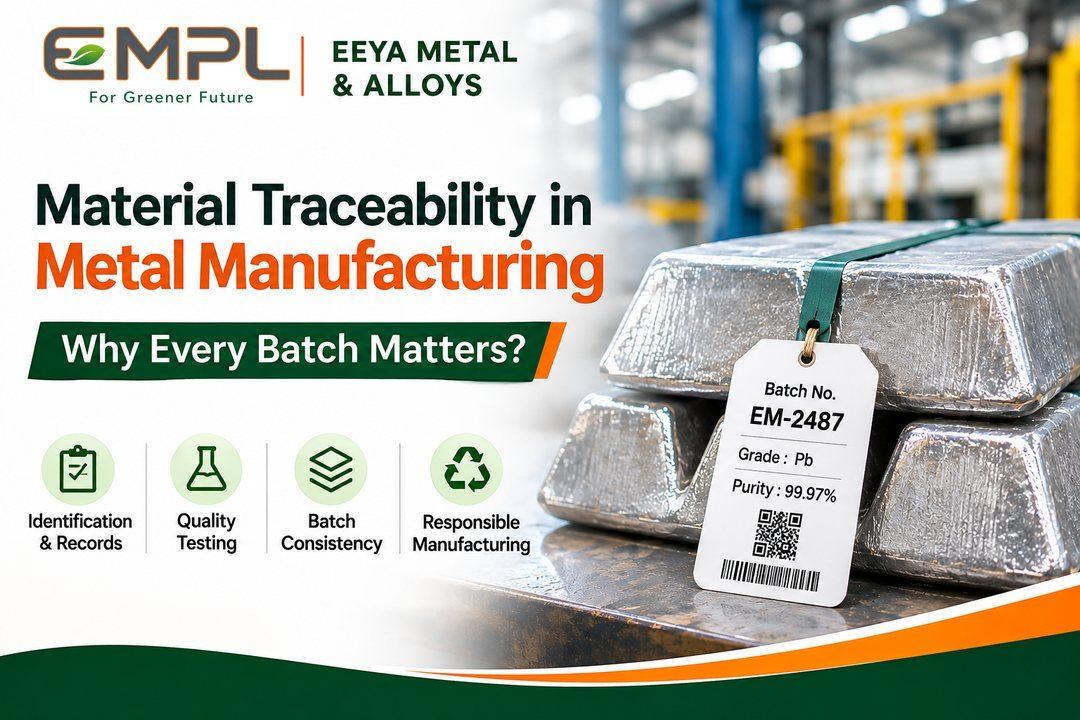
Material Traceability in Metal Manufacturing: Why Every Batch Matters
In industrial manufacturing, product quality begins long before the finished material reaches the customer. It starts with the identification of raw materials, controlled processing, quality inspection and proper documentation.
When businesses purchase industrial metals, knowing the material's grade and purity is important. However, understanding its composition, processing history and batch-level quality records can be equally valuable.
This is where material traceability in metal manufacturing plays an important role.
For manufacturers, procurement managers and industrial buyers, traceability provides greater visibility into the materials they source. It also supports quality control, documentation and more informed purchasing decisions.
Whether it is pure lead, remelted lead ingots or lead alloys, every batch should meet the specifications required for its intended application.
Let's explore why material traceability matters and how it contributes to reliable industrial manufacturing.
1. What Is Material Traceability in Metal Manufacturing?
Material traceability is the ability to identify and track materials through relevant stages of their production and supply journey.
In the metal manufacturing industry, this may include information about raw material sourcing, processing, refining, testing, storage and dispatch.
A structured material traceability system can maintain records such as:
-
Raw material identification and source information.
-
Material grades and specifications.
-
Processing and refining records.
-
Chemical composition and purity details.
-
Quality inspection and laboratory test reports.
-
Batch identification and production records.
-
Packaging and dispatch documentation.
These records help manufacturers establish a clearer understanding of the material being supplied.
For example, when purchasing lead ingots, an industrial buyer may need to verify the lead purity, chemical composition, applicable alloy specifications and associated quality documentation.
Having this information available makes material evaluation more systematic and transparent.
2. Why Is Batch Traceability Important?
In metal manufacturing, different production batches may have variations depending on raw material inputs, processing conditions and chemical composition.
Batch traceability helps manufacturers maintain visibility over these variations and associate quality records with specific material batches.
Here are four important benefits.
A. Better Quality Control
Batch-level identification helps connect inspection and testing records with the corresponding material batch.
If a quality concern arises, manufacturers can review the relevant records and investigate the affected batch more effectively.
B. Improved Material Consistency
Industrial applications often require specific material grades and chemical compositions.
Maintaining batch-level records helps manufacturers evaluate consistency across production batches and identify variations that may require attention.
C. Reliable Documentation
Industrial buyers frequently require supporting documentation before accepting a material shipment.
Depending on the product and agreement, this may include:
-
Material specifications.
-
Chemical composition reports.
-
Laboratory test results.
-
Inspection records.
-
Batch identification details.
Proper documentation makes it easier to verify whether supplied materials meet agreed requirements.
D. Greater Supply Chain Visibility
Traceability connects different stages of the industrial supply chain.
From raw material sourcing to finished metal products, documented information helps manufacturers understand how materials move through their operations.
This can support better coordination between suppliers, manufacturers and procurement teams.
3. The Role of Quality Testing in Material Traceability
Material traceability and quality testing are closely connected, but they serve different purposes.
Traceability helps identify and track materials, whereas quality testing evaluates specific material characteristics against defined requirements.
Depending on the metal and its intended application, quality evaluation may include:
Chemical Composition Analysis
Chemical composition analysis determines the proportion of different elements present in a metal or alloy.
For lead alloys, this may involve evaluating lead, antimony, tin and other relevant elements according to the required specifications.
Purity Testing
Purity testing helps determine the proportion of the primary metal and identify relevant impurities.
This is particularly important when sourcing high-purity lead for industrial applications.
Physical and Dimensional Inspection
Physical inspection may include checking the weight, dimensions, appearance and condition of finished metal products.
These parameters can be compared against agreed product specifications.
Batch-Level Documentation
Relevant inspection and test results can be associated with individual batches.
This creates a documented reference for reviewing material quality and consistency.
For further information about measurement traceability, refer to the National Institute of Standards and Technology (NIST):
https://www.nist.gov/metrology/metrological-traceability
4. Material Traceability in Lead Recycling and Manufacturing
Material traceability becomes particularly relevant in metal recycling because recovered materials may originate from different sources and require controlled processing.
In lead recycling, the general material journey can involve several stages.
Step 1: Material Collection
Lead-bearing scrap and recyclable materials are collected through appropriate channels.
Step 2: Initial Inspection
Incoming materials are evaluated based on their type, condition and suitability for further processing.
Step 3: Processing and Recovery
Suitable processing methods are used to recover lead from recyclable materials.
Step 4: Refining
Recovered lead undergoes refining to achieve the required purity and material specifications.
Step 5: Quality Testing
Relevant chemical composition and quality parameters are evaluated against the required specifications.
Step 6: Casting and Manufacturing
Refined lead can be converted into ingots and other suitable industrial product forms. Alloying elements may also be incorporated when specific alloy compositions are required.
Step 7: Documentation and Dispatch
Applicable batch identification, quality records and dispatch documentation are maintained.
A documented approach across these stages helps support material identification and quality evaluation.
Related reading: Lead Recycling Process: From Scrap Collection to High-Purity Lead
5. What Should Industrial Buyers Check Before Purchasing Metal?
For industrial buyers, selecting a metal supplier involves more than comparing prices.
Understanding the supplier's quality control and documentation practices can help reduce material-related uncertainty.
Here are six important considerations.
1. Material Grade and Specifications
Confirm whether the supplied material matches the grade and specifications required for your industrial application.
2. Chemical Composition
Ask for relevant chemical composition information and verify whether the material meets the agreed requirements.
3. Purity Levels
Understand the required purity level and request supporting test documentation where applicable.
4. Batch Identification
Check whether individual material batches can be identified through suitable records and documentation.
5. Quality Testing
Understand how the supplier evaluates material quality and whether relevant inspection or laboratory reports are available.
6. Supply Consistency
Evaluate whether the supplier can maintain the required material specifications across repeated orders.
These considerations can help procurement teams make better sourcing decisions.
Related reading: Lead Ingots: What Buyers Should Know Before Ordering
6. How Documentation Supports Industrial Quality Management
Documentation is an essential part of a structured quality management approach.
Records of material identification, inspection, testing and production help organizations review their operations and investigate quality concerns.
For metal manufacturers, maintaining appropriate documentation can support:
-
Better production monitoring.
-
Material identification.
-
Quality verification.
-
Batch-to-batch comparison.
-
Supplier evaluation.
-
More informed procurement decisions.
International quality management frameworks, such as ISO 9001, provide guidance for establishing and continually improving quality management systems.
However, maintaining material records alone does not establish ISO certification. Certification and compliance depend on the applicable requirements and independent assessment.
Learn more: https://www.iso.org/standard/62085.html
7. Why Material Purity and Composition Matter
Traceability becomes more useful when it is supported by accurate material specifications.
Two metal products may look similar but have different chemical compositions and industrial properties.
For example, pure lead and lead alloys are not interchangeable in every application.
The addition of alloying elements such as antimony and tin can modify material properties, making composition an important consideration during material selection.
For industrial buyers, some important parameters include:
-
Lead purity.
-
Antimony and tin content.
-
Other relevant alloying elements.
-
Impurity levels.
-
Applicable material grade.
-
Required product specifications.
Understanding these parameters helps buyers evaluate whether a material is suitable for their manufacturing requirements.
Related reading: Lead Purity Explained: What Industrial Buyers Should Know
8. EEYA Metal & Alloys: Connecting Responsible Recycling with Quality Manufacturing
At EEYA Metal & Alloys (EMPL), responsible metal recycling and quality-focused manufacturing are important parts of the company's approach to industrial metal supply.
The company specializes in recycling and producing pure lead and remelted lead ingots, with product purity levels of up to 99.97%.
Its stated quality approach includes:
-
Incoming material inspection.
-
Controlled processing.
-
Laboratory testing.
-
Batch-level documentation.
-
Material specifications based on customer requirements.
By connecting material recovery, refining and quality evaluation, EEYA aims to support industrial buyers looking for dependable metal solutions.
The company's focus on responsible recycling also contributes to a more circular approach to industrial resource utilization.
Explore more about the company:
9. The Future of Metal Manufacturing Depends on Better Visibility
As industrial supply chains become more interconnected, reliable material information is becoming increasingly important.
Manufacturers need more than a regular supply of raw materials. They also need visibility into material specifications, quality records and the processes behind production.
Material traceability supports this visibility.
It helps manufacturers evaluate material quality, maintain relevant documentation and make more informed sourcing decisions.
For suppliers, maintaining a structured approach to material identification and quality records can also strengthen communication with industrial customers.
Ultimately, a reliable metal supply chain is built not only on the quality of the material but also on the ability to understand and verify it.
Conclusion
Material traceability is an important consideration in modern metal manufacturing and recycling.
From raw material identification to chemical analysis, batch documentation and final inspection, every stage contributes to a clearer understanding of the material being supplied.
For industrial buyers, working with suppliers that prioritize material specifications, quality testing and appropriate documentation can make a meaningful difference.
At EEYA Metal & Alloys (EMPL), the focus remains on responsible metal recycling, quality-focused manufacturing and dependable industrial metal solutions.
Because every batch matters, and quality begins with knowing your material.
EEYA Metal & Alloys (EMPL)
Metals for a Stronger Tomorrow.
Website: https://www.eeyametal.com/
Frequently Asked Questions
1. What is material traceability in metal manufacturing?
Material traceability is the process of identifying and tracking materials through relevant stages of sourcing, processing, testing, storage and dispatch.
2. Why is batch traceability important in metal manufacturing?
It helps manufacturers associate material identification, inspection and testing records with specific production batches, supporting quality evaluation and investigation.
3. What documents should industrial metal buyers request?
Depending on the material and purchase agreement, buyers may request chemical composition reports, material specifications, laboratory test results, inspection records and batch identification documents.
4. How does traceability support metal recycling?
It helps maintain visibility over recovered materials, processing stages, quality evaluation and finished product documentation.
5. Is material traceability the same as quality testing?
No. Traceability tracks material information and its history, while quality testing evaluates specific material characteristics. Both complement each other.
6. Why is chemical composition important when purchasing lead alloys?
Chemical composition influences the properties and suitability of a lead alloy for its intended application. Buyers should verify the required grade and composition before purchasing.


